
This post may contain affiliate links. Please read our disclosure for more information.

For reasons I’ll address in a future post, I want to learn how to weld. So I sought instruction from my local community college and a funny thing happened. Within a half-hour after my first class started, I was welding.
Yep, I know it’s shocking. My community college apparently doesn’t give a crap about transforming me into a “well-rounded,” “woke,” or “critical-thinking” welder. All it wants to do is turn me into a novice welder with a firm grasp of the basics. That’s it. As such, I didn’t have to wade through a torturous amount of prerequisite bullshit.
There were no prerequisite courses on…
- Welding in American cinema
- The history of MIG welding
- Jim Crow and welding
- How the privileged turned welding into a poor person’s job
- Or, making welding more inclusive for lesbians, trannies, and other marginalized peoples
Nope. Other than having a pulse and $185, nothing was standing between me and my desired instruction. I was allowed to sign up for a welding class and start welding.
I can’t tell you how refreshing this no-bullshit business model is. For $185, I’m getting 101 hours of instruction from a seasoned welder and hands-on welding practice with professional-grade welding equipment. That’s an unbelievable bargain. And it’s exactly the kind of bargain that we should be seeing at our more rarefied suppliers of post-secondary education (i.e., our vaunted four-year colleges and universities).
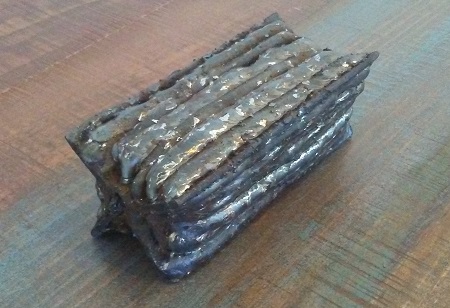
Quick aside. Here’s a picture of my first welding project. I had to spot-weld two right-angle pieces of steel together and then run welding beads within each quadrant until each quadrant was filled. Not exactly a thing of beauty, but it’s a start.
Another quick aside. Oh, and by the way, welding is hard and nasty. After a couple of hours of welding, I’m physically shot. And despite all the protective gear I have on, I still manage to suffer injury. After my first welding session, I went home to find my chest sunburned. Every welding session since then has brought tiny pock-burns to my shoulders and arms. Who knew melting metal would be so hazardous?
What the No-Bullshit Model Would Look Like at My Alma Mater
Baruch College is my alma mater and it’s part of the City University of New York (CUNY). For the current academic year (2018-2019), its undergraduate tuition and fees amount to $7,262. That works out to roughly $242 per credit ($7,262 divided by 30).
Now let’s suppose that I’m a recent high school graduate and I’m within commuting distance of Baruch College. And let’s further suppose the following:
- I have the grades and test scores to get into Baruch College.
- I want to become a data analyst so I’m interested in studying data analytics and quantitative methods.
- Baruch offers a no-bullshit micro-BBA with a major in data analytics and a minor in quantitative methods.
- And to earn this no-bullshit micro-BBA, you only need to take the courses that fulfill the requirements of the data analytics major track and the quantitative methods minor track.
To fulfill the requirements of the data analytics major track, you need to take eight courses (four required and four electives). To fulfill the requirements of the quantitative methods minor track, you need to take three courses (one required and two electives). That works out to 11 courses in total. But let’s add a calculus course to hone my quantitative reasoning skills and round out the no-bullshit micro-BBA requirements. What would these 12 courses cost me in time and money?
If I took three courses a semester, a no-bullshit micro-BBA would take me two years to complete. And at $242 per credit, a micro-BBA would cost me $4,356 per year for a total of $8,712.
Imagine that. A worthwhile credential for $8,712. And here’s the best part: there would be no reason to take out student loans. The current minimum wage in New York State is $11.10. If I lived at home with mom and dad and worked 20 hours a week at a minimum-wage job, I would be pulling in $10,656 a year before taxes. That’s not monster money, of course. But even after income and payroll taxes, that’s more than enough to cash-flow a no-bullshit micro-BBA from Baruch College.
The Paradox of the Four-Year College
Tuition at most of our public four-year colleges is pretty reasonable at the undergraduate level. At UT-Austin, it’s $376 per credit. At Buffalo University, it’s $337 per credit. At UNC-Chapel Hill, it’s $299 per credit. No-bullshit twelve-course micro-BAs from these three institutions would cost $13,536, $12,132, and $10,764, respectively.
Quick aside. To put the above per-credit costs into perspective, I looked up what the tuition and fees are for Harvard, one of our premier private universities. Tuition and fees for the current academic year amount to $51,925. That works out to a per-credit cost of $1,731. A micro-BA would set you back $62,316.
But sadly, no-bullshit twelve-course micro-BAs are only a figment of my fertile mind. In order to get a vaunted BA, you have to endure—and pay for—a lot of bullshit. In no particular order, here are the unnecessary costs that the current four-year college business model foists upon its students:
- A bloated administration (see here, here, and here)
- Student government
- Student clubs
- Fraternities and sororities
- Sports
- Resort-like dorms and amenities
- 60 to 80 credits that have absolutely nothing to do with one’s desired field of study
And this is why so many young people leave college with unconscionable debt (relative to the jobs they get) and must delay or forego such supremely adult—and life-fulfilling—behaviors as buying a home, getting married, and having kids. The four-year college, especially the public variety of this beast, is indeed a cheap way to screw up your finances for decades.
The Solution
The solution is rather straightforward.
- Live at home
- Work part-time
- Enroll at a local four-year college, preferably a public one
- Only take courses that pertain to your desired major
And this can be accomplished in one of three ways:
- Have congress pass a law that makes student-loan debt dischargeable in bankruptcy and forces colleges to co-sign every student loan their students take out. This would stop a lot of the nonsense we see in higher education. Colleges would have a strong incentive not to admit academically weak students, and colleges would have a strong incentive not to burden their degree programs with superfluous courses and excessive overhead.
- Have your state legislature pass a law that forces each public four-year college in the state to offer a no-bullshit twelve-course micro-BA for every BA it offers. This would be a super-easy way to dramatically lower the cost of a BA, providing, of course, it was only available to commuting students and carried the same weight as far as licensing exams and graduate school were concerned.
- Pursue a guerrilla micro-BA. Since the first two proposals are very unlikely to pass, your best option is to flex your maverick muscles and give the college-industrial complex the middle finger. Just go to a four-year college and only take twelve courses that pertain to your major. Flat-out refuse to take all those “required” courses that waste your time and money. The problem with this approach, however, is that you’ll likely get tripped up by your minuscule course load. Many upper-level courses are only available to those students who have achieved junior or senior status. But even if you do manage to pull off a guerrilla micro-BA, no licensing board or graduate school would honor your gumption. And many if not most employers would frown upon a guerrilla micro-BA as well. A college education sans a college degree is a very risky proposition.Quick aside. I looked up the most popular college majors and here are the majors that I think are best suited to a guerrilla micro-BA (i.e., employers in these fields might be somewhat receptive to your gumption):Business and Management
Communications
Computer Science
Political Science
Art
Foreign Languages
Information Technology
Performing Arts
Film and Photography
Music
Culinary Arts
Okay, as stated in proposal three above, proposals one and two will never see the light of day. The college-industrial complex will defend its cartel and business model tooth and nail. Here are the three likely defenses of the status quo that the college-industrial complex will offer and my response to each of them.
College-Industrial Complex: College is more than just learning a trade. It’s about developing critical thinking skills, celebrating diversity, and becoming a citizen of the world.
Me: Yeah, right. And healthcare is more than just curing disease and mending injuries. It’s also about prevention. So everyone should stop by his or her doctor’s office once a month for a battery of diagnostic tests. What possible harm could come from that? MRIs and blood tests conducted by out-of-network labs are very reasonably priced.
I can’t think of a more self-serving and tone-deaf counterargument to my micro-BA than this. Even if the non-trade-school aspects of the typical BA program have merit—and that’s a highly dubious assumption given the Progressive monoculture dominant on campus today—forcing parents and students who question the ROI of these costs to absorb them anyway is a very unethical business practice. Hello, college-industrial complex! Very few Americans can afford your “well-rounded” education. Wages have been stagnant for several decades, many households have trouble saving $400 (nevermind saving for retirement), and a shocking number of college graduates can’t even find employment in their chosen field of study. Can you tweak your business model just a tad and give the little guy and gal a break? Or is that asking too much?
College-Industrial Complex: If you commute to school and peruse a micro-BA, you’ll deny yourself the true “college experience.”
Me: Bullshit. You don’t even need to go to college to go to a college football game, join a club, pass out at a house party, or bully someone for wrong-think or wrong-act. You do need to go to college, however, if you want to take over a dean’s office without consequences. And pursuing a micro-BA would still give you that right.
College-Industrial Complex: There’s no need to use our four-year colleges for a micro-BA. You can get that at a community college.
Me: Wrong. Community college, because its mission is to accept everyone, is little more than grades 13 and 14. It’s therefore not nearly as academically challenging as our four-year colleges—especially our elite four-year colleges. Here’s the bottom line: we have a lot of problems in this country. If we hope to solve these problems, we need to push our smartest students intellectually but not break them (and the taxpayers) financially. Micro-BAs courtesy of our four-year colleges are the perfect solution for this goal.
Final Thoughts
Okay, groovy freedomist, that’s all I got. What say you? Do the “little people”—in defense of their honor and wallets—need to revolt against the bullshit-laden BA? Or am I being overwrought? The bullshit-laden BA has some faults, for sure, but all those faults can be easily fixed if the federal government just makes college “free” and forgives all outstanding student-loan debt. Let me know what you think when you get a chance. Peace.


Leave a Reply