This post may contain affiliate links. Please read our disclosure for more information.

Well into my 30s, I had one explanation for my inability to get ahead financially: malevolent forces. Evil people in Washington and Albany were conspiring against me. And so too were the people who ran the municipality I worked for. These twisted souls wanted nothing more than to see me suffer, to see me go through life as a bitter no-good debt slave, living paycheck to paycheck.
There was, of course, an element of truth to the above paranoia. Many of the laws and regulations passed in Washington and Albany did dampen my ability to generate disposable income and save and invest. And the municipality I worked for was a quid pro quo monstrosity. If you didn’t have connections and a penchant for donating to the Republican Party, you weren’t getting a promotion.
But then something clicked in my late 30s. I began to use the critical-thinking skills that the college-industrial complex blessed me with. And it all began with an observation and a question. Most of my friends and family were doing quite well financially and their innate abilities were no better than mine. So why, then, were they able to circumvent the “malevolent forces” running roughshod over the economy and not me?
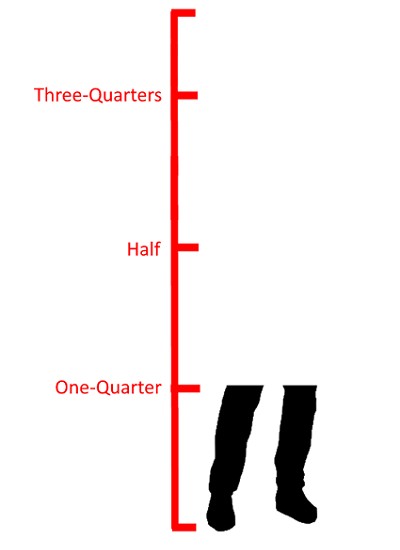
The Unbearable Stupidity of Being a One-Quarter Person
The truth of the matter is that I was a fi-loser (i.e., a financial loser) up until my late 30s, not because of “malevolent forces,” but because I only saw one factor in a four-factor situation. Yep, I was a one-quarter person. I was well aware of the people working against me, but I was tragically unaware of the way I worked against myself and the way I worked against others. I was also—to my eternal shame—tragically unaware of the people working for me.
And once I realized that there were three other factors to consider, my lack of financial success suddenly made complete sense. Let’s see why.
Self-sabotage. Up until my late 30s, I literally had no concrete work skills. I couldn’t audit a company’s books. I couldn’t set a broken bone. I couldn’t program a computer. Nor could I frame a house, weld two pieces of metal together, or operate a backhoe. Now I got two questions for you. In what economy on earth are people with no concrete work skills routinely rewarded with above-average salaries? And whose fault was it that I had no concrete work skills? Perhaps things would have been a tad different on the salary front if I used my free time in my 20s and early 30s to develop a concrete work skill rather than drink beer, watch sports, and sleep.
Evil me. Most of my more successful friends were married. This means most of them had an extra income, an extra brain, and an extra pair of hands helping them build wealth. I didn’t. I remained single until I was 40 years old. And the reason for this is simple: I was a class-A jerk. I treated women, in general, and girlfriends, in particular, very shabbily.
Benevolent forces. The traditional IRA became available in 1975. The Roth IRA became available in 1998. This is proof positive that not everyone in Washington was out to get me. There were actually people in Washington who wanted to see me succeed. And it’s not their fault that I failed to act on their goodwill until 2006 (that’s the year Mrs. Groovy and I opened Roth IRAs). I was legally allowed to earn a paycheck in 1977, and no external force from that point on ever stopped me from working extra hours and putting the proceeds of that effort into an IRA. The only thing that stopped me was me. Up until my late 30s, then, I combined loathsome ingratitude with wanton laziness—a ferocious one-two punch to the face of my financial well-being.
Be a Three-Quarter Person
You have a choice. You can be a one-quarter person and rail against the malevolent forces that you have no control over. Or you can be a three-quarter person and focus on the things you do have control over.
For the first 20 years of my adult life, I was a one-quarter person. And it got me absolutely nowhere. I was a fi-loser and a so-loser (i.e., a social loser).
Once I became cognizant of the other three factors, however, everything changed for the better. I stopped with the self-sabotage. I made myself more useful in the workplace and learned the ins and outs of personal finance. Simultaneously, I dedicated myself to being a good person. And this landed me the fabulous Mrs. Groovy and all the glorious financial wins that would follow in the wake of that magical union. Finally, I stopped being an ingrate. The people who invented Roth IRAs, health savings accounts, online banking, financial automation, low-cost index funds, and compound interest didn’t do so because they wanted to see me wallowing in abject poverty. They did so because part of them wanted to see me thrive financially. And I learned to honor that noble impulse by taking full advantage of their inventions.
Final Thoughts
Okay, groovy freedomist, that’s all I got. What say you? Are you a one-quarter person or a three-quarter person? And what do you suppose is holding back the millions of fi-losers in this country? I say the vast majority of them are being held back because they have a one-quarter mindset. Do you agree? Or do you think my distinction between one-quarter mindsets and three-quarter mindsets is utter nonsense? Let me know what you think when you get a chance. Peace.


Leave a Reply