This post may contain affiliate links. Please read our disclosure for more information.

I’m a big believer in egotrage on the housing front. Mastering one’s finances does more to secure one’s happiness than occupying a look-at-me home in a look-at-me location. So it pays to be very humble when it comes to your housing. With that said, here are ten reasons why you should buy a small home in a low-tax state.
Less Room to Hoard
Human beings are naturally pack rats, and this predilection only seems to be constrained by the size of one’s home. In other words, your capacity to hoard will grow to meet the capacity of whatever home you occupy. Big home = lots of stuff = wasting money and time on buying and caring for things you don’t need. Small home = minimal stuff = only buying and caring for things you need.
Lower Mortgage
Generally speaking, as long as we’re controlling for location, a small home is cheaper to purchase than a modest or large home. A cheaper purchase price, in turn, means a more manageable mortgage payment. Check it out:
| Size | Purchase Price | Cost of 20 Percent Down Payment | Mortgage Amount | Monthly Mortgage Cost for 30-Year Fixed (Excluding Taxes and Insurance) |
|---|---|---|---|---|
| Small (<1100 Sq Ft) | $125K | $25K | $100K | $430 |
| Modest (1100 to 1800 Sq Ft) | $250K | $50K | $200K | $860 |
| Large (>1800 Sq Ft) | $400K | $80K | $320K | $1,376 |
Lower Utility Bills
All things being equal, it costs less to heat and cool a small home than a modest or large home.
Lower Property Taxes
Property taxes are pegged to the assessed value of a home. A small home equals small assessed value, which in turn equals small property tax. And, if your small home happens to be in a low-tax state, the property tax bite is even more manageable. To show what I mean, let’s compare my modest home in Louisburg, North Carolina to my boyhood home in Plainview, New York.
Both homes are roughly the same size—around 1,500 square feet. According to Zillow, my Louisburg home is currently valued at $242K and my boyhood home is currently valued at $563K. Now throw in the fact that New York is a high-tax state, and the difference in property taxes between the two homes is staggering. Check it out.
2020 Property Tax Bite
Louisburg home: $1,835
Plainview home: $11,392
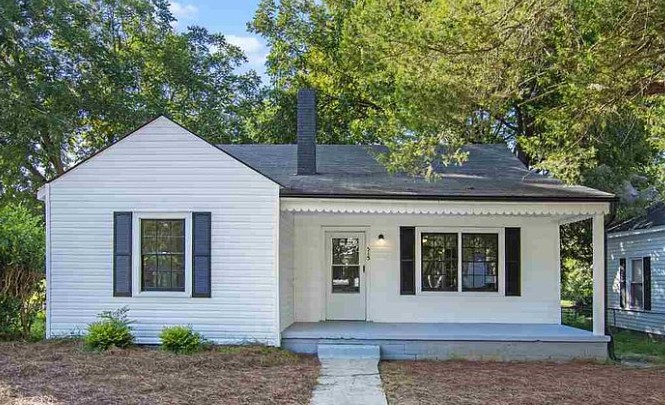
And don’t forget: my Louisburg home isn’t a small home (i.e., 1,100 square feet or less). My home is a modest home (i.e., 1,100 to 1,800 square feet). If I had a small home, my property taxes would be even lower. The below two-bedroom home in Louisburg is currently on the market for $129.5K. It’s 1,060 square feet, and its 2019 tax bite was $579.
More Money to Save or Invest
Your bed feels the same whether it’s placed in a small bedroom in a small house or a big bedroom in a big house. In other words, as long as your small home is in good repair, has all the standard amenities and utilities, and is surrounded by neighborly neighbors, the quality of your life would not be materially improved by moving into a larger, more impressive home.
The only thing you forego by choosing a comfortable small home over a comfortable big home is status. And if your ego can handle that crushing blow, a small home will increase the gap between your take-home-pay and your expenses—which, in turn, will increase your ability to save and invest and propel you faster toward financial independence.
And speaking of financial independence…
It Gives You an Easier Path to FI
When you own a small home outright, the investment portfolio needed to support that small home in retirement is much smaller. Check it out:
| Home | Current Value According to Zillow | Property Tax | Utilities | Insurance | Repairs and Maintenance (1% of Home Value) | Annual Cost of Homeownership | FI Savings Needed to Cover Housing Costs in Retirement |
|---|---|---|---|---|---|---|---|
| Small Louisburg Home | $129,500 | $579 | $1,883* | $322** | $1,295 | $4,079 | $101,975 |
| Modest Louisburg Home | $242,000 | $1,835 | $2,510 | $645 | $2,420 | $7,410 | $185,250 |
| Modest Plainview Home | $563,000 | $11,392 | $5,020*** | $1,290*** | $5,630 | $23,332 | $583,300 |
** Since the value of the small home is roughly half the value of my home, I thought an insurance cost equal to half of mine was fair.
*** The cost of utilities and insurance on Long Island are at least double what they are in rural North Carolina.
You Won’t Overspend on Government Services
When you’re competent socially, professionally, and financially, you gradually become aware of just how little you need the government. Mrs. Groovy and I have lived in North Carolina for nearly 15 years now, and all during that time we interacted with government employees four times: we once met with the North Carolina Real Estate Commission to deal with an unethical realtor (long story), we got pulled over by a cop in Charlotte for a minor traffic offense, we submitted a septic permit application to the Louisburg building department clerk, and we met with the septic permit inspector to see where she wanted the leeching field for Groovy Ranch to be located. That’s it.
Now a question: If all you want from government is basic government services (i.e., roads, police, firefighters, parks, libraries, the enforcement of thoughtful business and safety regulations, etc.), how do you minimize your tax bite when the government refuses to unbundle its services? Well, for starters, you live in a small home in a low-tax state. This way, your property taxes are so low, it doesn’t matter that you’re paying for a lot of government services that you neither want nor need.
To show what I mean by this, let’s compare the property tax of our three sample homes to the 2020 Groovy Income of $32,500. As you can see, the property taxes for the two Louisburg homes are such a trivial percentage of our income, it makes paying for a lot of superfluous government services much more palitable.
| Home | Property Tax for 2020 | Percentage of 2020 Income |
|---|---|---|
| Small Louisburg Home | $579 | 1.8% |
| Modest Louisburg Home | $1,835 | 5.6% |
| Modest Plainview Home | $11,392 | 35.1% |
You’ll Contribute Very Little to a Corrupt and Inept Public School System
If you want your child to have little regard for America and freedom, have a primitive understanding of money and wealth-building, and have no worthwhile skills to bring to the labor market when he or she turns 18, you could not find a better way to legally administer spiritual, cultural, and financial filicide than to subject your child to 13 years of public school.
I, of course, don’t want our young people to turn into America- and freedom-hating losers. So I want to contribute as little as possible to our corrupt and inept public schools. And, thankfully, because I live in a modest home in a low-tax state and my property taxes are low, my contribution to the miseducation of our youth is tolerable—that is, it’s just mildly stomach-wrenching. Here’s a comparison of the miseducation contribution between a small Louisburg home, my current Louisburg home, and my boyhood Plainview home:
| Home | Property Tax for 2020 | Percentage of Property Tax that Goes to Public Schools | Annual Contribution to Miseducation* |
|---|---|---|---|
| Small Louisburg Home | $579 | 40% | $232 |
| Modest Louisburg Home | $1,835 | 40% | $734 |
| Modest Plainview Home | $11,392 | 60% | $6,835 |
Less Pretentious Neighbors
There are no gated communities in Louisburg, North Carolina. Nor are there any McMansions. There are a few big homes, of course, but the vast majority of Louisburg homes are either modest or small.
Now, I don’t know if there’s a connection between big, look-at-me homes and haughtiness, but Louisburg has a decided lack of either. And this means there’s no pressure to put on airs. Your neighbor in overalls will think just as kindly of you whether you’re driving a brand-new Lexus or a 20-year-old Ford pickup truck.
More Freedom
Owning a small home outright in a low-tax state is not just the most affordable housing you can find in America—it’s some of the most affordable housing you can find on the planet. The two-bedroom Louisburg home featured in this post costs $4,079 annually to run and maintain. That works out to a monthly housing cost of $340. Now, where in Mexico, Thailand, Ecuador—or any other popular ex-pat destination—can you find comparable housing, that’s situated in a safe neighborhood, is reasonably close to big-city culture and amenities, and costs less than $340 a month for rent and utilities combined?
Used strategically, a small home means more freedom. It allows you to retire sooner and it’s kinder to your wallet. And this, in turn, means you have more time and money to do what excites you—you know, like spending a month in Australia, writing one inane blog post after another, and welding a lifesize bison out of rebar and scrap metal.
Final Thoughts
Okay, groovy freedomist, that’s all I got. What say you? I say a small home in a low-tax state is something that will do wonders for your finances and your sangfroid. But maybe I’m missing something? Maybe a small home in a low-tax state is too Mayberry, too Peyton Place, and such an environment would slowly eviscerate one’s soul? Let me know what you think when you get a chance. Peace.


Leave a Reply to Emmanuel Goldstein Cancel reply