This post may contain affiliate links. Please read our disclosure for more information.

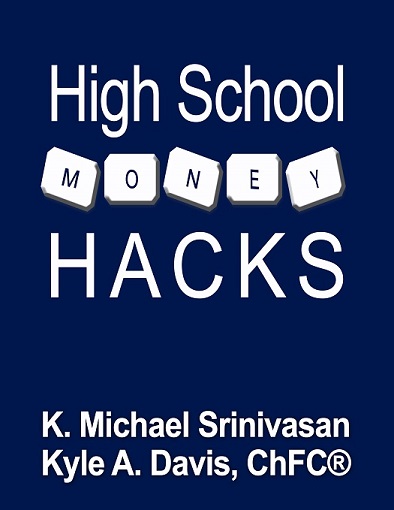
Michael Srinivasan, who writes over at Stretch A Dime, gave me a copy of High School Money Hacks which he co-authored with Kyle Davis. He requested a book review and I immediately agreed. Then I suddenly panicked and went into severe nail biting mode. “What if it stinks?” I thought. Well, I wasted a perfectly good manicure for no reason because High School Money Hacks is an excellent book.
High School Money Hacks is for students but it’s also perfect reading for anyone who knows little about finance. While the material is straightforward, it’s geared toward an intelligent and mature reader who wants to learn. And it’s easy to recognize why this book is sorely needed at the high school level. A 2015 Gallup poll revealed that only 42% of those students they surveyed say they are learning how to save and spend money.
High School Money Hacks is presented in six sections:
- Time Value of Money
- Power of Compounding
- High School Money Hacks
- College Education
- Credit Report and Credit Scores
- Further Reading and Recommendations
Time Value of Money
The authors waste no time and jump right in with explaining the present value (PV) and future value (FV) of money. They assume we have some basic knowledge of Excel. If we don’t, they suggest we Google “Time Value of Money Calculator” for additonal tools. They “travel the timeline” with us in both directions, from PV to FV and from FV to PV in mathematical exercises. They stress that when we make any financial comparison we must use the cash value at the same point in time.
The Power of Compounding
This section contains the best line in the book: “Compound interest works better uninterrupted.” The authors caution against self-sabotage by taking money off the table from a compounding position and stress that compound interest works best over a long period of time. They introduce Annual Percentage Rate (APR), Effective Annual Rate (EAR) and Annual Percentage Yield (APY) to illustrate how loans and loan balances are calculated. The authors also explain inflation and its effects and they warn us that money is never really “safe” just sitting in a savings account.
High School Money Hacks
Everything in personal finance hinges on this question—are you a producer or a consumer? Become an expert at producing, the authors recommend, and you will become financially successful. This section offers a creative take on work, side gigs, hobbies, and work from home opportunities. The authors also illustrate how our paychecks are eroded by taxes and FICA. They provide an overview of IRAs, budgeting, and saving. And once again, the authors emphasize the power of compound interest and point out how time is the most powerful force in finance.
College Education
Here we get an analysis of college costs, the cost of education vs. potential income earnings, income gaps caused by lack of education, student loans, 529 plans, and scholarships. My favorite part here is “how much will you make?” The authors speak of loan debt vs. return on investment and point out how it makes no sense to spend $200K for college only to graduate with the capacity to make $35K.
Credit Report and Credit Scores
Here we learn how our credit report and credit score greatly impact our financial lives. The authors introduce us to the three credit reporting agencies and explain what goes into a FICO score. I appreciate that they direct us to annualcreditreport.com, which is the only legitimate site for obtaining a free credit report. They also caution us to be careful about every financial decision we make since one bad move may have a ripple effect.
Further Reading and Recommendations
High School Money Hacks concludes with several links to videos and guides on compound interest, budgeting, IRAs and insurance, as well as other resources.
Final Thoughts
A budgeting professor of mine in graduate school was incensed about the lack of financial education among her students. Consequently, she set aside her curriculum one evening to give a basic lesson in personal finance. She included budgeting, balancing a checkbook, and using credit responsibly in her primer. Yes—this was at the grad school level!
Obviously, finance is a missing link in our education system. Although many states now require that public high school students take a personal finance course before they graduate—many states do not. Various nonprofits and government agencies provide resources to teachers for developing a financial curriculum to bridge the gap, including Jumpstart.org, which publishes a National Standards in K-12 Personal Finance Education to further financial literacy.
In the meantime it’s the responsibility of parents to insure their children learn basic financial literacy. And High School Money Hacks is tailor-made for putting a teenager on the right path towards saving, investing, and using debt reasonably. I highly recommend this book and suggest that parents and teens explore the chapters and exercises together. And if you’re facing decisions about college costs and loans, take a look at this video from Dee-1.
Groovy Review: ☮️☮️☮️☮️
High School Money Hacks
By Karthigan Michael Srinivasan & Kyle A. Davis, ChFC
$4.99 at Smashwords


Leave a Reply to Vicki@MakeSmarterDecisions Cancel reply