This post may contain affiliate links. Please read our disclosure for more information.

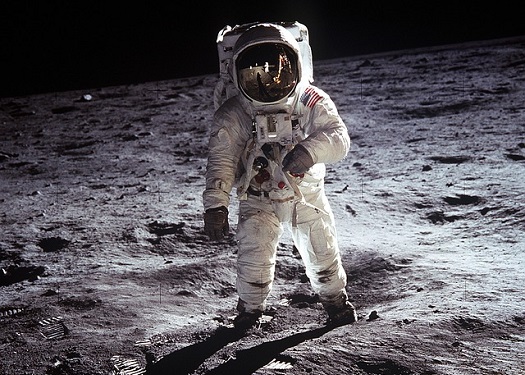
Fifty years ago today, two Americans walked on the moon. I was seven years old at the time, just old enough to appreciate how remarkable that achievement was.
I still get chills thinking about the summer of 69. My world revolved around two things: the New York Mets and the Apollo moon mission. And while the heroics of Seaver, Agee, and Kranepool thrilled me beyond words, I instinctively knew that they and their teammates were still the undercards to Armstrong, Aldrin, and Collins. In 1969, astronauts were the supreme, top-dog idols in the pantheon of American Idols. And this was especially true for every red-blooded American child in Plainview since the lunar module was built right next door in the town of Bethpage.
So around 10:30 at night on July 20, 1969, my parents roused me, my brother, and my sister from our beds and ushered us into the family room. And there, a little after 11, I stared at a clanking monstrosity of a television and watched a man step off the Bethpage-built lunar module and plant his feet firmly on the moon.
Peak Competency?
I’m damn proud of the Apollo program. It wasn’t Russian, Chinese, or Mexican feet that walked on the moon; it was American feet. The Apollo 11 mission was the exclamation point on American exceptionalism. America worked. America got things done. America routinely made the impossible possible. Consider the following:
- In a little over a year (410 days, to be precise), America, in the throes of a horrific economic downturn, no less, built the Empire State Building, an astonishing 102-story skyscraper that remained the world’s tallest building for 41 years.
- In less than four years, America invented the atomic bomb, built the planes to drop that fearsome weapon, and then dropped two of them on the last remaining Axis Power to end WWII.
- In less than nine years, America built the rockets, equipment, and technology to put people on a rock that is 240,000 miles away from earth.
Now consider a few things that recently came across my radar:
- According to US Debt Clock.org, America’s national debt has now eclipsed $22.5 trillion.

- According to a Seattle radio station, KOMO News, homeless people are seriously marring the quality of life in Seattle. Check out this rather sobering video.
- And, finally, according to the John Hopkins Institute for Education Policy, the Providence, RI, public schools are worse than dismal. Ninety percent of Providence students aren’t proficient in math, and 80 percent of Providence students aren’t proficient in English. Let those numbers sink in. At least 80 percent of Providence students are being left behind.
I’ve brought up these stark examples of incompetence, not to rain on the supreme competency of the Apollo 11 mission, but to voice a concern that’s been troubling me for several years now. Did America reach peak competency in 1969? I know that probably strikes you as ridiculous. After all, the typical American’s cell phone today has a hundred thousand times more computing power than the computer in the Apollo 11 command module. But I think I’m on to something, and to prove it, I want you to ponder these questions:
Over the following time intervals—one year from now, four years from now, and nine years from now—what do you suppose will happen?
- Will America’s national debt become more onerous or less onerous?
- Will the homeless situation in Seattle become better, worse, or remain the same?
- Will Providence students become impressively more literate and numerate or pretty much exhibit the same level of ineptness?
Frankly, I don’t see any of these things improving. Whether we’re talking about a year from now, four years from now, or nine years from now, the national debt will be just as terrifying (if not more so), the homeless situation in Seattle will be just as heartbreaking, and the students of Providence will be just as ill-equipped to thrive in a knowledge-based economy as the students of Providence today.
Something happened to America. Instead of the eagle landing, the dodo has landed. Oh, sure, we still show flashes of supreme competency—the space shuttle, the internet, and the cell phone immediately come to mind. But when it comes to the everyday competencies of rearing children, managing household finances, mastering workplace responsibilities, and governing waistlines, we appear—to say the least—bewildered. And when it comes to the crucial societal competencies of educating children, cultivating safe communities, providing affordable healthcare, managing pensions, controlling our borders, and protecting the public purse, we appear equally flummoxed.
Again, I don’t want to come across as a nattering nabob of negativity. I sincerely hope I’m wrong. I just can’t say with conviction that America works, that America can tackle any challenge. For far too many Americans, especially those at the helm of our most important institutions, it not only appears that “failure IS an option” but also appears that failure is NO BIG DEAL.
Neil is surely spinning in his grave.
Final Thoughts
Okay, groovy freedomist, that’s all I got. What say you? Did America reach peak competency in 1969? Or am I delusional and America is just as competent as it was 50 years ago? But more importantly, do you have any Apollo 11 stories to share? I’d love to hear them if you do. Peace.


Leave a Reply to Steve poling Cancel reply