
This post may contain affiliate links. Please read our disclosure for more information.

I detest politics. I’m at the point now where I find it impossible to even look at a politician, regardless of party. So why does this blog occasionally veer into an area of life I find so objectionable? Because failure to do so would be a dereliction of duty. Let me explain.
Achieving financial independence isn’t only about mastering math. If it were, achieving financial independence would be easy. Just spend less than you earn, invest the difference, and keep doing that until you have accumulated twenty-five times your annual expenses.
But very few Americans have mastered the math. And it’s not because they’re stupid or wantonly indifferent to building wealth. It’s mostly because they’re ignorant. They’ve been told their whole lives that debt is normal, that bigger is better, and that more stuff makes you happier and sexier. And after years of being pounded by this spendthrift ideology, they have forged habits, attitudes, and biases that make it impossible to master the math.
Achieving financial independence then is as much about fixing wealth-crippling habits, attitudes, and biases (i.e., behavioral economics) as it is about mastering math. And any blogger dedicated to financial independence would be guilty of malpractice if he or she ignored this. After all, who is going to challenge our hyper-consumerist culture? Who is going to say, for instance, that a Roth IRA stuffed with maxed-out contributions will do more for one’s long-term happiness than a closet stuffed with clothes and shoes? The credit card companies? Macy’s? Madison Avenue?
Okay, now onto the dreaded P word, politics.
The below image comes from an article in the October 2015 issue of Money in which author Paul Keegan provides an in-depth analysis of a California family’s finances. Notice what the family’s biggest expense is? It’s government. Forty-five thousand dollars is slightly more than thirty percent of its household income. And that 45K represents just the easily quantifiable cost of government (property and income taxes). It doesn’t include the taxes the family surrenders when it pays utility bills or buys food, clothing, and gas. If we accounted for these taxes, the cost of government would easily reach one-third of its household income.
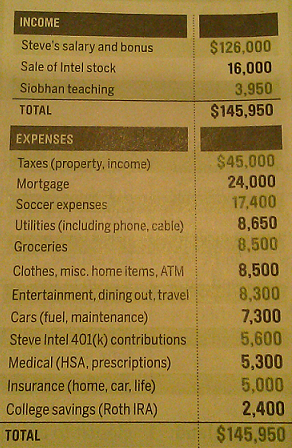
Now suppose for a moment that the cost of government for our California family miraculously drops without compromising the sum and quality of the goods and services the government provides. Rather than eating up thirty-three percent of its household income, taxes eat up twenty-five percent. Our California family would now have nearly $12,000 extra every year to throw at its 401(k) retirement account ($48,163 – $36,487 = $11,676). Its quest for financial independence would become decidedly easier.
Our California family is hardly alone. For most Americans, the cost of government is their largest household expense. But no personal finance blogger I know writes about ways to reduce the cost of government. Sure, they write about ways to reduce the current year’s tax bite, such as tax-loss harvesting and larger 401(k) contributions. But these tax-deferring strategies, while helpful, aren’t available to everyone, and don’t address the problem. They don’t make it any less costly to incarcerate a felon, educate a child, or pave a road.
Dropping the Ball
There are three components to financial independence. There’s the behavioral part (train your mind to spend less than you earn and save the difference), the income part (earn more), and the frugal part (cut expenses so you have more to save). Financial bloggers do a great job of covering the behavioral and income components of financial independence. And for the most part, they do a great job of covering the frugal part. But consider this: Mr. Money Mustache, perhaps the most interesting financial blogger out there, has made a very strong case that cars are a major detriment to the long-term financial well-being of most Americans (see here, here, and here). But how great an expense are cars for the typical American family compared to government? For our California family, car expenses were five percent of its household income. Government expenses, on the other hand, were thirty-three percent. And, yet, no where in his prolific blog, does Mr. Money Mustache tackle the cost of government. And by no means am I saying this to slight Mr. Money Mustache; this just isn’t in the consciousness of the financial blogging world.
Something’s wrong here. Financial bloggers take great joy in helping people reduce their household expenses. I’ve seen posts extolling the virtues of tiny houses; posts urging readers to cut the cord; and innumerable posts showing people how to reduce their food, clothing, entertainment, travel, borrowing, portfolio, and smartphone costs. But I’ve never seen a post showing people how they can reduce their government expenses. Why is the cost of government off limits? Are financial bloggers worried about offending their audiences? Is the challenge of reducing the cost of government too hard?
The position taken here at Freedom Is Groovy is that government is a major household expense that has a decades-long record of only growing larger, and it would be incredibly irresponsible of Mrs. Groovy and I if we 1) didn’t raise an alarm, and 2) didn’t offer ways to reduce its costs.
Final Thoughts
First, I don’t equate eliminating government with reducing its costs (although that would certainly do it). So I’m not going to suggest that we get rid of the military, discontinue Social Security, and shutdown the Department of Education. No, here reducing costs will mean providing a public good at a reduced price without sacrificing its quality. The cost of humanely incarcerating a felon, for instance, drops from $50k a year to $40k. That’s what I mean by reducing the cost of government.
Second, politics here will not mean hurling firebombs at either Democrats or Republicans. If you want that, you’ll need to visit another site. My goal here is to make government less costly. It’s not to put more Ds or Rs in Congress.
Third, reducing the cost of government will not be the dominant theme of this blog. It will still be mostly about Mrs. Groovy and I’s quest for financial independence and the groovy things we’re doing to get there. But reducing the cost of government has to be part of the discussion. Government is too big and costly to ignore. I suspect that one out of every four or five posts will be about politics. That strikes me as a reasonable balance.
Okay, with that said, I want to give you a sampling of the politics this blog will explore. Here are some rough ideas to reduce the cost of K-12 education:
- Have small class sizes for math and English (10-12 kids) and large class sizes for everything else (30-40 kids).
- Get rid of tests for everything but math and English. Churches don’t require their parishioners to take notes and cram for tests. But their parishioners, by showing up and participating, learn the lessons of the Bible. This teaching model can work just as well for social studies, science, history, civics, and computers. As long as the kids show up and participate, they’ll learn.
- Bring the adjunct model of higher education to lower education. Wouldn’t it be great to have a retired ER doctor teach a single biology class for the entire school year? And do so for a nominal fee ($1,500 – $2,000)? If adjuncts taught twenty-five percent of a given high school’s classes, that school’s instructional budget would fall twenty percent. If adjuncts taught fifty percent of classes, the instructional budget will fall forty percent.
- Get volunteers from the community to help clean classrooms, mop floors, cut grass, and perform other custodial services.
- Get out of the pension business. The
defined-contributiondefined-benefit model is too costly. Enroll new teachers in a 403(b) plan and provide an employer match of up to four percent of their contributions.
What do you think, groovy freakin freedomists? Will the above ideas reduce the cost of lower education, the largest component in your property tax bill? Will they reduce the cost but sacrifice the quality of our schools? Will they kill the teaching profession? Are they nuts? Don’t worry about hurting my feelings. I’d love to hear from you.


Leave a Reply to Lindsay @ The Notorious D.E.B.T. Cancel reply