
This post may contain affiliate links. Please read our disclosure for more information.

Years ago, when losing weight was easy and I had an incredible shock of hair, I worked for a highway department. And every year we would produce a sweeping schedule and mail it to every household in the municipality.
I hated the sweeping schedule. Why? Because we sucked at abiding by it, and there were legions of homeowners who couldn’t wait to harangue us every time we screwed up.
Yes, I know it sounds ridiculous, but there were people who lived for the sweeping schedule. They would remind their neighbors, “the sweepers are coming, the sweepers are coming.” And to prepare for this momentous event, they would rally their neighbors to temporarily forego street parking—thus granting us unprecedented access to the grime and debris that settled in the gutters.
And then they would wait, and wait, and wait. The street was free of cars. The gutters were begging to be scrubbed. “WHERE ARE THOSE BLOODY SWEEPERS, DAMMIT?”
We sucked at maintaining the sweeping schedule because every sweeping jurisdiction had one sweeper and every sweeping jurisdiction was swept at the same time. So if the sweeper from, say, jurisdiction 1 broke down, there were no back-up sweepers to maintain the schedule. Sweeping in jurisdiction 1 was put on hold until its sweeper was repaired.
So one day, just after I got verbally abused by a citizen whose street was swept two days late, it hit me. Our streets weren’t that filthy. They didn’t need to be swept six times a year. Three times a year was enough. Wouldn’t a schedule in which half our sweeping jurisdictions were active and half were idle make more sense? This way, if a sweeper broke down, there would be plenty of back-up sweepers to maintain the schedule. The idea of alternate-month sweeping was born.
When I took my idea of alternate-month sweeping to my boss, I remember thinking, “This is so obvious. Someone must have thought of it before. And if we ain’t doing it, there must be a good reason why.”
Well, it turned out, nobody had thought of it. It also turned out that all the higher-ups had a “why the hell didn’t we think of this before” epiphany. Alternate-month sweeping was thus put into operation. And I became a legend—the inventor of alternate-month sweeping. My finest contribution to the general welfare of the community during my twenty years of public service.
I thought about alternate-month sweeping recently for two reasons. First, fiddling with a sweeping schedule can’t be the crowning achievement of my life. Am I that pathetic? Surely I can do something more beneficial for mankind. Second, I recently had an idea that strikes me as something very analogous to my alternate-month sweeping idea; that is, it’s an idea so obvious and simple that people are either blind to it or assume it’s already been explored.
My idea is the Junior IRA, and I blogged about it a couple of months ago. For those of you who didn’t see that post, here’s the link. The Junior IRA, or JIRA for short, is hardly earth-shattering. It’s just a Roth IRA for children that removes the work requirement and allows anyone to fund it. Here’s how it would work in a nutshell.
Every newborn in the United States would leave the hospital with a birth certificate and a JIRA.
The newborn’s parents or guardians would have the authority to choose the JIRA’s custodian (Vanguard, Fidelity, Schwab, etc.).
The only eligible investment option for a JIRA would be a low-cost, total-stock-market index fund (Vanguard’s VTSMX fund, for instance).
The federal government and the birth state would each be required to contribute $1,000 to every newborn’s JIRA. Since there are roughly four million babies born in the United States every year, this feature would cost roughly $8 billion dollars annually (four billion from Uncle Sam and four billion from the states). Eight billion dollars is, of course, a lot of money. But in the context of what the feds and and the states currently spend (over $4.6 trillion annually), it’s pocket change.
The maximum contribution to a JIRA in the first year of a child’s life would be $3,000 ($2,000 from the government and $1,000 from other sources). The maximum contribution after the first year would be $1,000 annually.
Contributions to a JIRA could come from any source (parents, grandparents, aunts, uncles, charities, foundations, churches, etc.) and could not be used by the contributor for a tax deduction.
As soon as a child turned 18, her JIRA would immediately convert to a Roth IRA.
Now maybe I’m nuts, but I don’t see a downside to this idea. Who loses? Who is made worse off by the Junior IRA? We allegedly have a retirement crisis in this country. Corporations aren’t going to take care of our children in old age. The government’s too inept, corrupt, and broke to be counted on. Wouldn’t it be great, then, if our children could to start saving for their retirements while they were still in their diapers?
If you do see any flaws in my Junior IRA, please let me know. In the meantime, I’ve decided to alter my retirement plans. In addition to picking up garbage, baking bread, and traveling the world, I’m going to champion the Junior IRA. In fact, I’m so pumped about this new endeavor, I’m already fantasizing about my tombstone.
Here rests Mr. Groovy
Inventor of alternate-month sweeping and the Junior IRA
1961 – 2061
Final Thoughts
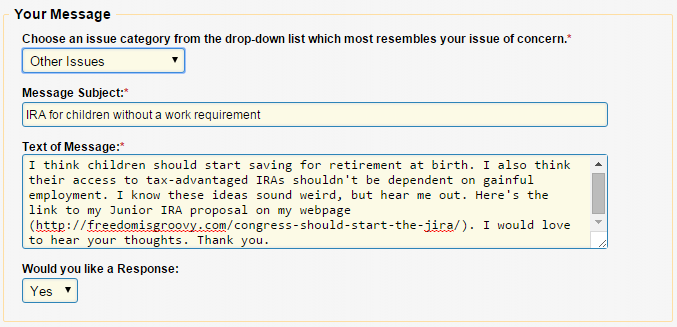
I have no idea how to make the Junior IRA a reality. I figured I’d start by reaching out to my congressman and two senators. Here’s a screenshot of the email I sent them last night. I’ll keep you posted on their responses. It should be fun. And if anyone knows how a poor schlub with no following can get a law passed by Congress, please let me know.


Leave a Reply to Mr. Groovy Cancel reply