This post may contain affiliate links. Please read our disclosure for more information.

The last few weeks have been tough on investors. Wall Street has been taking it on the chin—thank you, Omicron, thank you, Mr. Inflation, and thank you, Mr. Fed Chairman for signaling that the Fed will soon be raising interest rates.
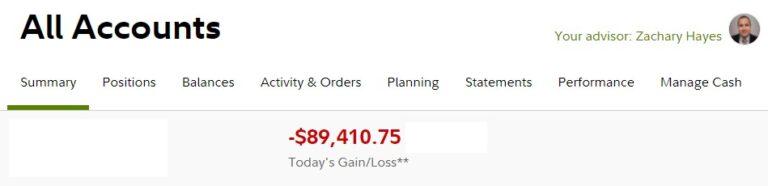
Well, regardless of what’s made investors jittery, stocks have been losing value bigly and I haven’t been able to avoid the carnage. Here’s a screenshot showing how much my Fidelity portfolio went down on one particularly jarring day during this current pullback (1/5/2022):
Learning to Love the Investing Process
Twenty years ago, I would have locked in the above paper loss by selling. My aversion to loss back then was very intense.
But since I began investing in earnest in 2006, I have learned to subdue the get-out-of-dodge impulses of my lizard brain. And I have learned to subdue these impulses for three reasons:
Faith
Every financial guru that I’ve been acquainted with—from Warren Buffett to J.L. Collins—has stressed the view that Wall Street pullbacks are great buying opportunities. And the reason they stress this view is simple: Wall Street eventually comes back. It may take three months, it may take a year, but at some point in the future, the Dow will be higher than it was the day before the pants-soiling Wall Street pullback began.
Early in my investing career, I didn’t have experience as a teacher. All I had were these financial gurus telling me to ignore the FUD from the financial media and carry on with my dollar-cost-averaging. Fortunately, these financial gurus struck me as honest brokers of financial advice, and that leap of faith gave me the courage to start ignoring the get-out-of-dodge impulses of my lizard brain.
Mrs. Groovy
Mrs. Groovy has always had ice in her veins when it comes to investing. Paper losses just don’t bother her. When I showed her our paper loss on 1/5/2022, she just shrugged and asked me what I wanted for dinner.
Mrs. Groovy has proved to be an awesome antidote to whatever wavering faith I have had in my gaggle of financial gurus. This was especially true in 2008 and 2009. Back then, as the raging recession was eviscerating our investment portfolio, she not only refused to let me sell any shares of our stock funds but she also made me increase my contributions to my 401(k).
Experience
I have now been investing in earnest for nearly 16 years. So I now have real evidence to juxtapose against the advice of my gaggle of financial gurus and against the steely nerves of my beloved Mrs. Groovy. Here is the progress of our net worth for every year after 2014:*
| Year | Net Worth Gain or Loss |
|---|---|
| 2015 | +1.22% |
| 2016 | +15.00% |
| 2017 | +12.73% |
| 2018 | -7.93% |
| 2019 | +13.89% |
| 2020 | +22.54% |
| 2021 | +29.35% |
* I don’t have net worth data prior to 2015 because I only began tracking our net worth in 2015.
What makes the above evidence particularly compelling is our net worth progress after 2016. Mrs. Groovy and I didn’t retire until October of 2016. This means the net worth results of 2015 and 2016 were largely affected by our employment and our ability to contribute roughly 50 percent of our gross household income to our investment portfolio. If we stopped working in 2014, our net worth would have gone down in 2015, and our net worth wouldn’t have come close to going up 15 percent in 2016.
After 2016, however, we had no more W-2 income to invest. Our only means to tweak our net worth results has been rebalancing, which we have typically done twice a year. And yet despite the absence of W-2 income, and despite the need for portfolio withdrawals to cover at least half of our living expenses, our net worth has gone up four of the five years since retirement. And Wall Street was particularly kind to us in 2021. We spent way more in 2021 than we did the previous four years, and our net worth still went up more in 2021—both percentage-wise and dollar-wise— than it did in any previous year.
Final Thoughts
Okay, groovy freedomist, that’s all I got. What say you? I say investing is a process you need to teach yourself how to love. There will be days and years in which the Wall Street gods treat your investments with abject rudeness. But there will also be days and years in which the Wall Street gods treat your investments with robust kindness—and thankfully, the kind days and years are more numerous than the rude days and years. As long as you learn to ignore Wall Street rudeness, and continue to invest through pullbacks, corrections, and crashes, your net worth will likely have a very satisfying upward trajectory. Peace.


Leave a Reply to Financial Samurai Cancel reply