
This post may contain affiliate links. Please read our disclosure for more information.

In a post from last week, The Government Isn’t Going to Save You, I coined the phrase Personal Responsibility Warrior (PRW). Now, granted, proclaiming to be the inventor of a phrase is a rather bold statement. But I googled “personal responsibility warrior” and nothing came up, so I’m running with it. Not only am I the inventor of the Junior IRA, but I’m also the dude who introduced the phrase “personal responsibility warrior” into the American lexicon. Not too shabby for a little ol’ country blogger from North Carolina.
But what exactly is a PRW?
Well, for starters, a PRW is an adult of sound mind and body. A PRW is also a firm believer in rugged individualism. But beyond that, I haven’t formulated a precise definition. Creating a skeleton, after all, is easy. Putting meat and flesh on that skeleton is another matter.
What follows, then, is my attempt to put some meat and flesh on my PRW skeleton. I want to capture the mindset of a true PRW; that is, I want to capture the values and attitudes that a person must embrace to be recognized as a PRW.
Here we go.
You’re Not Entitled to Free Stuff
The first rule of the PRW mindset is this: You’re not entitled to someone else’s money, time, or goodwill just because you have a pulse. It’s your job to feed, clothe, house, educate, and doctor yourself. Not your mommy’s. Not the government’s. It’s also your job to save for your retirement. And if you fail to provide for yourself, you shouldn’t be surprised if you wind up miserable and broke.
Adopting this no-entitlement rule isn’t as difficult as you might suppose. It has three very important qualifiers.
First, when I say it’s your job to provide for yourself, I’m not advocating a super-extreme form of self-sufficiency. I don’t expect you to slaughter your own cows, make your own clothes, build your own car, construct your own home, and perform your own surgeries. No man or woman is an island. In order to provide for yourself, you will need help.
Second, help from others doesn’t violate the no-entitlement rule as long as the help is voluntary. If you ask your friend to help you fix your car, and your friend agrees to sacrifice his time, great. If you need food, and Walmart agrees to exchange a specified amount of groceries for a specified amount of money, super. This kind of help aligns perfectly well with the no-entitlement rule. No one is forcing your friend to be a good friend. No one is forcing Walmart to stock its stores with food and sell that food to you at a price you can afford.
Finally, third, help from others only poses a problem when it’s coerced. Hello government. But even here, some coerced help doesn’t run afoul of our no-entitlement rule. Think roads, parks, courts, and national defense. You pay for these goods and services out of your taxes, and you get to use these services immediately, without any stipulations. It doesn’t matter what your age, ethnicity, education level, income, and occupation might be. This coerced help, in effect, is you helping yourself. You’re exchanging value for value.
Now consider things such as food stamps, Pell grants, farm subsidies, Obamacare, and the mortgage-interest deduction. All taxpayers pay for these goodies, but not all taxpayers can take advantage of them. You need to have a mortgage, for instance, in order to take advantage of the mortgage-interest deduction. So if you happen to benefit from one of these goodies directly, you’re getting coerced help that runs afoul of our no-entitlement rule. Others are being forced by the government to subsidize your life; you’re receiving coerced charity.
But here’s the rub. Our country is so teeming with coerced charity, it’s impossible to avoid. And since foregoing all instances of coerced charity is neither feasible nor practical, there’s only one way for a PRW to abide by the no-entitlement rule: Don’t depend on coerced charity. Mrs. G and I, for instance, will be getting a very generous Obamacare subsidy starting in 2017. But we didn’t base our retirement on this subsidy. We saved enough money to pay for our health insurance ourselves. If Trumpcare subsidies prove to be a lot less generous, we won’t have to return to work. We’ll still be members of the idle class. We thus view coerced charity as an unavoidable bonus—a cherry atop the sundae of American life, if you will. If it’s thrust upon us, fine. If it’s taken away, oh well.
A PRW never expects or depends on coerced charity.
If Something Needs to Be Done, You Do It
Years ago, on some wintry day in the early 90s, I hopped on the LIRR with a couple of my buddies and headed to Penn Station. We had tickets to a New York Rangers game. And as my buddies and I traipsed through Penn Station on the way to Madison Square Garden, we saw the goalie on our hockey team (not the Rangers, our local beer-swilling amateur team) handing out sandwiches to the homeless.
If you play ice hockey at all, you learn pretty quickly that goalies are weird. But feeding the homeless in Penn Station? By yourself? On a Saturday night? That’s a special kind of weird. So my buddies and I went over to say hello and investigate.
It turned out our goalie had been feeding the homeless for a number of years. Once a month he would make a couple dozen sandwiches and trek into Penn Station from Long Island. When he was done handing out the sandwiches, he would go home. That was it. He wasn’t trying to be a hero. He was just trying to make life on this planet a little less “poor, nasty, brutish, and short.”
I’m glad I remembered this goalie. Yes, he was freakin’ weird. But he was a good egg, and the charity he performed in Penn Station is a perfect example of the second rule of the PRW mindset: If something needs to be done, you do it. You don’t wait for others. You don’t ask for permission. You don’t make excuses. You get off your butt and you show some initiative.
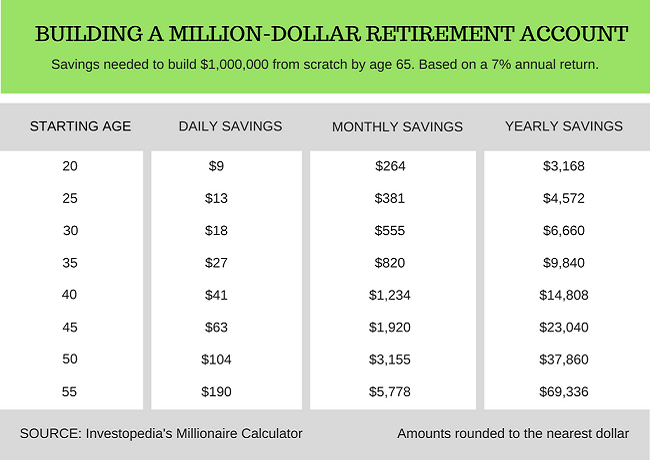
This do-it rule doesn’t just apply to charity. It applies to all aspects of life. Say, for example, you want a million dollars. If you’re a PRW, you first find out what you have to save monthly to build a million dollar portfolio (see chart below). Then, once you have that information, you do whatever you have to do to increase your income and/or decrease your expenses to make that monthly nut possible. If it means getting a second job, you get a second job. If it means getting rid of cable, you get rid of cable.
A PRW rejects apathy and inertia. A PRW embraces action.
Admit Your Screw-Ups and Welcome Your Punishment
I’m 55-years-old, and by virtue of reaching that advanced age, I’ve made tons of mistakes. And the most important thing I’ve learned about mistakes, especially the ones done at work, is this: own them immediately, don’t let them fester or become surprises. Tell your boss, or whoever was affected by your mistake, that you screwed up and you have absolutely no excuse. And you know what will happen to you? In most cases, nothing. The natural inclination of man is to accompany his mistakes with excuses and finger pointing. Do the opposite, and the people affected by your mistakes will find your honesty so refreshing, they’ll be hard pressed to exact punishment. And if they do exact punishment, so what? Punishment is the price you pay for honor.
A PRW owns his or her mistakes—proudly.
Don’t Use the Irresponsibility of Others to Justify Your Own Irresponsibility
A lot of Americans aren’t exactly paragons of responsibility. Consider the following statistics.
- Roughly 40% of births in America are to unwed mothers.
- In 2014, 47,055 Americans died from drug overdoses.
- Households with a zero or negative net worth have an average of $10,308 in credit card debt.
- In 2015, the average college graduate had a little more than $35,000 in student loan debt.
- The average cost of a wedding in America is now $26,645.
- The average cost of a new car in America now exceeds $33K.
- The median size of a new home in America is now 2,467 square feet. That’s over 900 square feet more than the median size of a new home built in the 1970s.
- Roughly 1 out of every 3 Americans over the age of 55 hasn’t saved a dime for retirement.
- Roughly 47% of American adults would have a hard time coming up with $400 if disaster struck.
But wait, it gets worse. Not only are Americans irresponsible when it comes to sex, recreation, and finances, but they’re also irresponsible when it comes to providing counsel. Just google “income inequality” and you’ll find no shortage of bright people who claim that opportunity in America is dead. See here, here, and here.
Really? America is an opportunity desert? Only those born into wealth and privilege can get ahead?
I’m the first one to admit that America has a lot of problems. But the sentiment that America lacks opportunity, especially for the poor, is total crap. Want to see what a real lack of opportunity looks like? Check out the video below. And as you watch those poor Indian children picking through garbage, consider our circumstances. Every child in America has access to a free public school. Every child in America has access to a free public library. Potable water, electricity, and internet service are so abundant, no one even thinks about these necessities. You don’t need permission from the government to delay childbearing. You don’t need permission from the government to learn a skill. You don’t need permission from the government to excel at work. You don’t need permission from the government to save money and invest in the stock market. And thanks to things such as WordPress, Twitter, Facebook, Instagram, Pinterest, YouTube, Khan Academy, Udemy, Coursera, Etsy, EBay, Craigslist, TaskRabbit, Fiverr, EatWith, AirBnB, and Uber, the barriers to starting a business or a side-hustle have never been lower. And America lacks opportunity?
Okay, enough of my ranting. Let’s get to the point of this section.
Irresponsibility has been mainstreamed in America. You wouldn’t be weird if you procreated irresponsibly. You wouldn’t be weird if you waged war against your liver and brain cells every weekend. You wouldn’t be weird if you spent more than you earned and had debt up to your eyeballs. And you wouldn’t be weird if you drank the America-sucks Kool-Aid and refused to better your life. But you also wouldn’t be a PRW.
A PRW doesn’t use the irresponsibility of others to justify his or her own irresponsibility.
Prepare for the Worst
When Mrs. Groovy and I moved down to Charlotte, NC, we had enough money to buy a McMansion. But rather than buying a McMansion, we bought a very modest home instead. Why? Because we were preparing for a worse-case scenario. We didn’t know what our incomes were going to be after we relocated, but we figured we’d both be able to get jobs paying at least $10 an hour. We therefore bought a house that could be supported by two $10-an-hour jobs.
Happily, Mrs. Groovy and I managed to secure jobs that paid more than $10 an hour. Supporting the house we bought became a breeze. The money we saved from not buying a McMansion was used to turbo-charge our retirement savings. And that’s the beauty of preparing for the worst. When the worst doesn’t happen, you find yourself in a very comfortable place—with a lot more opportunities.
A PRW prepares for the worst.
Final Thoughts
Okay, groovy freedomists, there’s my stab at defining a personal responsibility warrior. How’d I do? Did I nail it? Or did I totally muck things up? Let me know what you think when you get a chance. And have a great weekend. Peace.


Leave a Reply to Ms. Montana Cancel reply