This post may contain affiliate links. Please read our disclosure for more information.

There’s no Dave Ramsey of scrap-metal welding. In other words, I can’t fire up my Kindle and download The Seven Baby Steps to Building Your First Lifesize Bison out of Scrap Metal.
Aside from the John Lopez video below, I’m basically on my own. Just me and whatever critical-thinking skills I have left from nine years of higher education completed last century.
But this John Lopez video is enough to get me started. My first task is to emulate John and create a bison frame/skeleton with an accompanying bison silhouette.
Easy-peasy, right? Wrong. The first week of my bison build wasn’t exactly my finest hour. Let’s see why.
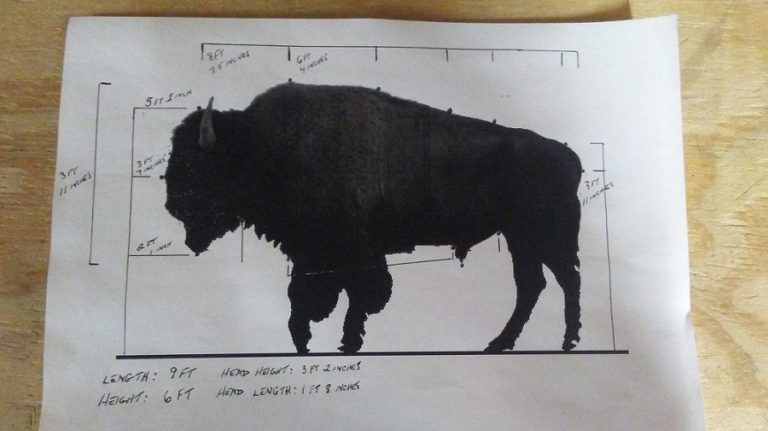
The week started off promising. I downloaded a side view of a wild bison, photoshopped it to create a silhouette template, and then calculated the corresponding dimensions of a lifesize bison. Here’s a picture of my silhouette template.
The next step, of course, was to get the metal to create the frame and silhouette. But before I purchased the metal, I had to consider some pretty formidable limitations. I don’t have anything close to a real metal fabrication shop. I have an entry-level stick welding machine (Hobart 160i Stickmate) and an entry-level angle grinder (Porter Cable). That’s it. No chop saw, plasma cutter, or oxyacetylene torch—my shop is pitifully devoid of anything capable of cutting and bending heavy-duty metal. So with these limitations in mind, then, I went online and ordered 22-gauge sheet metal and piping from Lowe’s and a pair of sheet-metal shears from Harbor Freight.
And then I did some research on stick welding thin metal. Talk about putting the proverbial horse before the proverbial cart! The consensus of the online pros was that welding anything thinner than 16-gauge was a bridge too far for stick. My Lowe’s metal order was thus a major screw-up. As soon as it arrived, I returned it.
The only good thing about this major screw-up was that it forced me to find a better metal supplier. Lowe’s metal offerings were quite limited. I couldn’t find anything thicker than 22-gauge. The supplier I found in Raleigh, however, had a much more robust selection. I was able to get the same quantity of metal at the thicker gauge (i.e., 16-gauge) and the cost was a third less than Lowe’s.
“Okay,” I said to myself. “I got the right metal. Let’s build me a bison frame and silhouette.”
Not so fast. I had the right metal. I didn’t have the right welding rods.
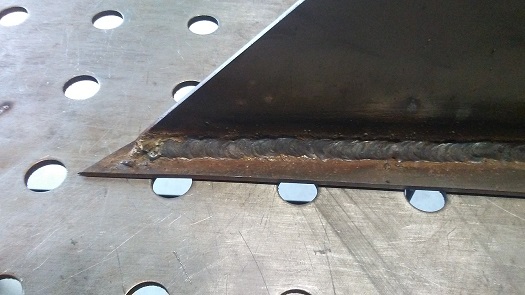
I have 7018 welding rods. Below is a picture of a bead from a 7018 rod connecting two pieces of 14-gauge metal. Hardly a thing of beauty, but pretty good for a novice welder.
And here’s what welding two pieces of 16-gauge metal looks like with the same rod. Ouch. Is that ugly or what!
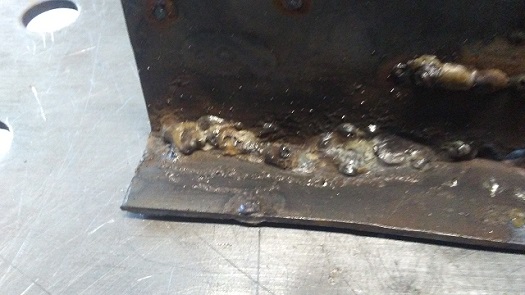
It turns out the 7018 rod runs too hot for 16-gauge metal. What I need to use are 6013 rods.
Dutifully humbled by the welding gods again, I went back online and ordered some 6013 rods. They should arrive early next week.
Final Thoughts
Okay, groovy freedomist, that’s all I got. I was hoping to have a glorious bison frame and silhouette for you today, but my vast welding ignorance conspired against me. Have a great weekend. Peace.


Leave a Reply to Pat Cancel reply