
This post may contain affiliate links. Please read our disclosure for more information.

Anyone remotely familiar with the Freedom Is Groovy website knows that I’m not a fan of government. And it’s not because I’m a meanie. Government has inherent flaws that make it a poor steward of people’s money. Consider the following.
- Government is often a monopoly. A private company, for instance, can’t start up a DMV and develop a competing system for registering cars and ensuring driver competency.
- Government has basically tenured employees. Once a government employee passes his or her probationary period, it is very difficult to fire him or her.
- Government has a mandated clientele. Via taxation, you pay for a government service whether you want it or not, and regardless of how miserable its quality becomes.
- Government can legally provide favors and goodies to some citizens and not to others. “Hello, Corporation X. Move your headquarters to our city and we’ll give you a 20-year property tax abatement.”
Now a question. What is the likelihood that a monopoly business with tenured employees, a mandated clientele, and a legal right to sell favors is going to provide exemplary goods or services? If you answered that the likelihood is remote, go straight to the head of the class.
Again, I know this is a personal finance website and a post on government isn’t always welcome. But bear with me. Government waste and corruption, because they drive up the cost of government, are the enemies of those striving for financial independence. After all, if all levels of government were less wasteful and corrupt, the typical household’s tax bite might drop from 33% of household income to 25%. The typical household would then have thousands of dollars more to invest in the market annually.
Now, the four inherent flaws of government are to politicians what temptation is to the average Joe trying to save money. They are always there to scuttle good intentions. And no politician, regardless of party, has the willpower to forever resist them. Combating government waste and corruption, then, has less to do with electing the “right” politicians and more to do with crafting a system that accounts for these four inherent flaws.
But in order to craft such a system (i.e., institutional checks over politician willpower), we have to get beyond the partisan divide. Enter my good blogger buddy Chris from Apathy Ends.
I reached out to Chris about a guest post describing his first-hand experience as a “public servant.” Thankfully, he leapt at the opportunity. And bully for us that he did. Chris is a wonderful writer with a irreverent sense of humor who never fails to enlighten me or make me laugh. Also, his first-hand experience with government starkly demonstrates that government waste and corruption isn’t a Democrat or Republican thing. It’s a four-inherent-flaws thing. Those nasty flaws ruined his little corner of government in the Midwest as much as they ruined mine in the Northeast.
Okay, groovy freedomists, without further ado, here is one man’s unvarnished view of government. Take it away, Chris.
Excited to be back on the Groovy platform where disdain for the government runs rampant and making whoopie is encouraged before signing off.
Don’t believe me? Check out the conclusion of Mr. Groovy’s “I Don’t Know Diddly Squat” post:

I took his advice literally and maybe bent the meaning of his post:
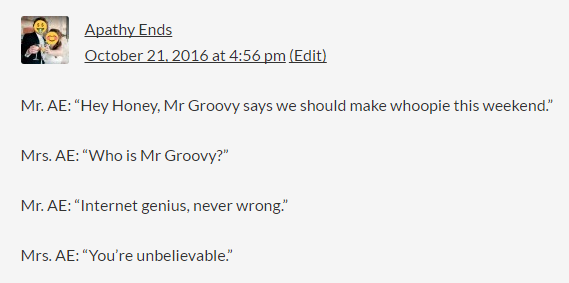 Proud to say, I was awarded funniest comment of the year 2016 (a title I look to defend).
I think Mr. Groovy should work this into his bio, though:
Early Retiree, Finance Blogger, Eco-Superhero and “Internet Wingman”
Ok. Back to why I am here today. I shared some first-hand knowledge of the pervasive waste of resources I witnessed while working for the City Government and Mr. Groovy asked me If I would come elaborate. Here we go.
The Pervasive Waste of Your Tax Dollars: City Government Edition
For two summers, I had the pleasure to work for the city I grew up in, mowing lawns and doing general park maintenance. It was pretty easy as far as jobs go.
See tall grass?
Make it shorter.
Even with the simplicity, it was a disastrous mess of inefficiency, laziness, and BS rules that poo-pooed all over your hard earned money.
Before digging into the details, I want you to know that I was only an 18-year-old kid looking for a little cash between school years to blow on beer and gas. I knew what they were doing was wrong and unethical, but I wasn’t about to stir the pot. Everyone seemed generally happy with the status quo.
“Windshield Time”
I will never forget the first time I experienced “Windshield Time.” It was my second week on the job and I was paired up with a full-time employee who’s name I can’t remember (I do remember he had a killer mullet, though). We had just finished mowing a park and loaded up the mowers. He looks over at me and asked if I was “ready for some Windshield Time.”
I asked him what he meant and the explanation boiled down to: We finished all the parks on our schedule today. And if we want enough work to do the rest of the week, we need to burn some of the afternoon.
He proceeded to put the truck in drive, and we spent 45 minutes driving around the city doing jack s*%t.
To put this in perspective, we were in a 4 door Ram truck, pulling a steel trailer big enough to fit two 6′ wide Toro lawnmowers. I put our miles per gallon somewhere around 11-12.
It wasn’t enough to just slack off sitting in the truck, we needed to be moving. Talk about wasting gas.
Oh…all of our driving around was done with the windows down and the air-conditioning on full blast. Never understood that one.
We were only working 6.5 hours…By Design
Looking back at how the workday was designed, productivity was doomed from the start.
Everyone’s scheduled hours were from 6:30 AM to 2:30 PM—pretty much the best hours you can get over the summer (if you could get up that early). But just because we were slated to work the typical 8 hour workday, doesn’t mean we did. Let’s count the ways we thrashed our productivity.
Paid Lunch: Minus 30 minutes
When you only have an 8 hour work day, who gets paid for lunch?
Travel time back to the shop for lunch: Minus 30 minutes
For some reason, everyone was required to come back to the shop for lunch. I have worked lawn mowing jobs and concrete jobs in the private sector, and there is no way a company is paying someone to drive back to headquarters just to eat.
Morning Meeting: Minus 20 Minutes
The full-time guys had a 20-minute meeting every morning, even though they did the same exact thing 90% of the days. The summer help sat on a bench until they wrapped up.
Line to Punch out: Minus 10 minutes
We weren’t allowed to work overtime, so everyone had to punch out within 5 minutes after 2:30. That means there was a line of 50-60 people to get through 2 machines. Needless to say, first in line was a coveted position that required a 10-minute head start.
Throw in some windshield time, a little screwing around, and we are working under 5 hours a day. Pathetic.
You had to do something ridiculous to get fired
Four people in 2 years did find ways to be incompetent enough to get fired.
One failed a drug test.
Two seasonal workers were caught napping in the truck behind WalMart. And they were only caught because a WalMart employee called the city and asked why one of our trucks was behind the store.
The other one was a full-time employee who was driving the City truck back to his house and parking it in his garage for hours, multiple times a week. The only reason he was caught?…he lived in another city and a neighbor finally called our city and asked why one of our trucks went to their neighborhood every day.
Thankfully some citizens could keep us in check.
Unions Play a Key Role
This is a dicey topic. All full-time employees of our City government, and the County government, we are a part of a union.
Generally, I like the theory behind unions. Defend the workers from unsafe working conditions, make sure they are earning a fair, livable wage, etc., etc.
But I do have some issue with the outcomes of their existence.
- I believe you should be paid on performance, not on time served. Telling someone they are going to make X every year will take away from their drive to perform and innovate.
- They make it hard to “trim-the-fat.” Once someone was “in,” you had to go through bureaucratic hell to get rid of them. They protected people who blatantly disregarded direction from management and would have been S*%t Canned if they worked at a non-union shop.
Two other weird things I witnessed that the only explanation was “The Union”
- The full-time union guys filed a complaint when the head of the department picked up trash when he visited parks. Something about “taking work away from the Union” (even though it was work they weren’t planning on doing).
- When they operated their plows in the winter, they would lift up the blades when they drove down County roads because, “That was the County’s responsibility and they couldn’t start a turf war with them.”
For those of you that say this is one example, in one place—I have seen my fair share of unionized workplaces (Coal mines, processing plants, power plants) and my experience with the City is not unique.
Am I generalizing, yes, of course, there are hard working, passionate people that work for unions, but a few good apples don’t save the bunch.
Ripe for Privatization and Private Bids
I feel like I am going a little Ron Swanson with this section, but the government has no business running mowing crews, maintenance crews, or really anything that would be better served by an open bidding process.
We can hold private businesses accountable for their work and drive bidding wars where the most efficient company wins.
How Government Bids Work:
If you have never been to or witnessed a public bid for government work, I will break it down for you quick.
The city publishes the specs and requirements they have for the project. Usually, it is a set of blueprints with professional standards they expect to be followed. Private companies interested have a set amount of time to figure out cost (materials, labor, overhead, profit) and put together a bid for the work to be completed. Once they are satisfied with the bid, they seal it up in an envelope and deliver it to the City.
On the pre-established date, an open-to-the-public “bid opening” takes place. The lowest bid wins the contract.
Since the companies bidding are for profit, they are responsible for keeping costs low and having their employees function in an efficient manner, which ultimately saves the taxpayers money. If a contractor doesn’t perform up to par, they are let go. Without having to fight a union.
I used to estimate for a concrete contracting company and submit bids for City and County road/sidewalk work.
General Maintenance has private contract bidding written all over it. Let businesses compete instead of blowing a ton of taxpayer cash.
One Last Jab
My biggest problem with the wasting of taxpayer dollars: we don’t have a choice to pay them, and to treat our money with such disrespect is embarrassing.
Thank you for letting me share my experience Groovies!
Mr. Groovy here again. Wow, Chris. Your brief encounter with government employment is eerily similar to my two-decades long encounter. It’s amazing how petty and callous public servants can be toward the taxpayers. And I love that you brought up the topic of privatization. I always thought my municipality missed a wonderful opportunity to do right by the taxpayers by not privatizing garbage collection and street sweeping. Sure, contracting out those services would have created a new set of problems, but it would have done more to keep government costs in check than voting in the “right” politicians.
Okay, groovy freedomists, what say you? Is the secret to less costly government better politicians or better institutional checks? Let me know what you think when you get a chance. Peace.


Leave a Reply to Grant @ Life Prep Couple Cancel reply