
This post may contain affiliate links. Please read our disclosure for more information.

Here in Charlotte, a local radio station airs Robert Kiyosaki’s syndicated show on Saturdays. I’ve caught it a couple of times while running errands with Mrs. Groovy, and I enjoyed it. He and his wife were engaging, and his guests were interesting. But I can’t claim to be a fan of Mr. Kiyosaki. In fact, the man bugs me. Let me explain.
Some years ago, I read his famous Rich Dad Poor Dad book. I liked it for the most part. But giving my level of financial sophistication at the time, that’s not saying much.
There were two things in particular about this book that made me uneasy. First, his Poor Dad, who is his father, is portrayed as a financial nincompoop who can barely provide for his family. But his father had a Ph.D. and eventually became the head of Hawaii’s education department. Granted, his dad didn’t have enough scratch to own a G5. But was he “poor”? The current superintendent of Hawaii’s DOE is a six-percenter. What was Hawaii paying its superintendents in the 60s? Minimum wage?
The second thing I didn’t like about Rich Dad Poor Dad was that the Rich Dad was never identified. Call me nuts, but if someone was as influential in my life as Rich Dad was in Kiyosaki’s life, and I wrote a book about this incredibly influential person, I would mention his or her name. To be fair, Kiyosaki claims that his Rich Dad was a very private person and didn’t want to be identified. Fine. I get that. So don’t write a non-fiction book. Write a parable. Use fictional characters to transmit the financial lessons of the two dads. Writing a “non-fiction” book that never identifies the pivotal dad, and thus makes it impossible to determine the veracity of your claims, strikes me as the work of a huckster. Cue up The Music Man, boys and girls. Rich Dad Poor Dad made my BS meter buzz violently.
“Okay,” some of you are no doubt protesting. “Maybe his Rich Dad brand was built on a fabrication. Who cares? What counts is today. And in this regard, Kiyosaki is helping thousands of people improve their financial lives.”
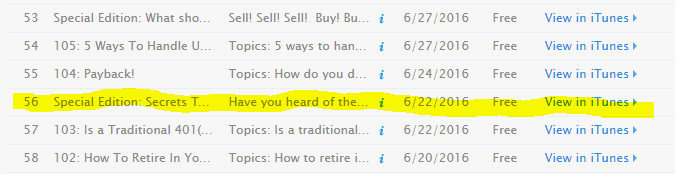
Is he really? A couple of weeks ago, I caught a “Special Edition” of the Financial Rockstar podcast, hosted by Scott Alan Turner. (I couldn’t find a link to this podcast on Turner’s website, oddly enough. You can find it in iTunes, though, by doing a search on Scott Alan Turner. This particular podcast is right after podcast 104. See below).
Turner went to one of Kiyosaki’s free Rich Dad seminars to feast on a bounty of financial delectables. But what he got instead was the financial equivalent of rice cakes. Oh, the delectables were there if you wanted them. But to get them, you had to sign-up for a future three-day seminar and shell out $495. Kiyosaki’s free Rich Dad seminar was nothing more than a glorified sales pitch. And this is what bugs me about Kiyosaki. Why does he have to play games with people? Are bait-and-switch and obnoxious up-selling really the hallmarks of an honorable businessman? And why does his information—assuming it’s worthwhile—cost so much? Dave Ramsey’s Financial Peace University costs $99. Heck, you can learn the meat and potatoes of investing on Jim Collins’s blog for free.
Okay, now on to another person that bugs me, Mr. Robbins.
For years I refused to take Tony Robbins seriously. How could I? His late-night infomercial was usually sandwiched between a Carleton Sheets infomercial and a spray-on-hair infomercial.
But then I heard Tony on a Tim Ferriss podcast. And he sounded remarkably cogent. So I decided to read his latest book, Money, and I was pleasantly surprised. Great book. I invested a modest amount of time reading it and I walked away with a deeper understanding of personal finance. Awesome. That’s the way an author/reader relationship should work. The reader invests a little in the author (whether in time, money, or both), and the author provides the reader with knowledge that is far more valuable than what the reader invested. Tony had won me over.
It was with this fan-boy mindset, then, that I sat down to watch the Tony Robbins documentary on Netflix called, “I Am Not Your Guru.” But very quickly things went south. About a quarter of the way through it, I felt like I was watching psychological pornography. I mean, do I really need to see some poor soul stand before a thousand people and recount the horrors of sexual abuse? How does that help me (assuming I was an attendee)? How does it help her? Is Tony trained to psychologically dissect people the way he does? What are the long-term consequences of his techniques? I’m sure they profit him. But do they profit the people who emotionally spill their guts?
And what’s with all this tier crap? Pay X and you get to see Tony up on the stage. Pay 2X and you get to share Tony with 99 other attendees in a room. Pay 4X and get an hour one-on-one with Tony. Hey, I’m a staunch capitalist, but this business model makes me wretch. It’s one thing to have a tier system when the price of entry starts at $40. But when the price of entry starts at $4,000? That tier crap should be out the window.
Final Thoughts
Okay, groovy freedomists, that’s all I got. Kiyosaki and Robbins are in my dog house. Am I wrong? Am I being too hard on these fellows? Don’t hold back if you think I’m mistaken. I’d love to be convinced otherwise. Peace.


Leave a Reply to Mike Cancel reply