This post may contain affiliate links. Please read our disclosure for more information.

Anyone familiar with this blog knows that I’m not a fan of government. Part of this stems from a study of human nature. People are just better stewards of their own money and liberties than they are with others. Expecting bureaucrats to treat tax money as if it’s their own money, or to treat the laws and regulations they promulgate as if they’re only going to be enforced against themselves and their families, is expecting way too much. Human beings never have, and never will, roll like that.
But part of my distaste for government also stems from personal experience. For twenty-one years I worked for a municipal highway department on Long Island. So I saw up close and personal how “public servants” treated the taxpayers. And believe me, it wasn’t pretty. My guess is that our municipality gave the taxpayers fifty cents worth of service for every tax dollar they surrendered to us.
So what accounted for this dismal service? In a word, management. Management—the politicians and commissioners who ran my municipality—was far more concerned with staying in power and rewarding its political backers than with providing the taxpayers with excellent service at a reasonable cost.
This indictment of my former bosses isn’t made lightly. Most of the commissioners I knew or worked for were basically good, decent people. And I don’t want to think ill of them. But they did have feet of clay, and they did embrace two workplace norms that obliterated any chance we had of becoming the New England Patriots of municipal government: the culture of sloth and the culture of tribute. Let me explain.
Culture of Sloth
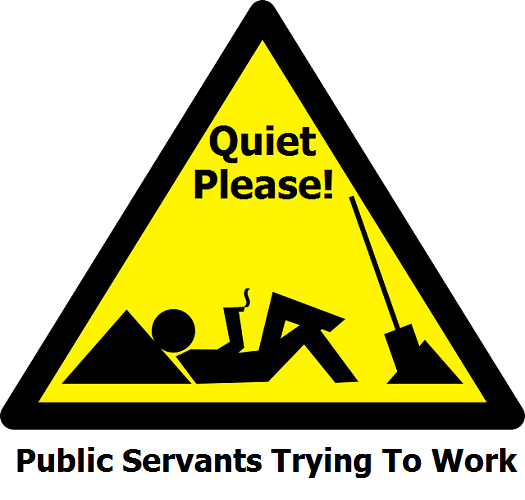
For three years during my government career, I worked as the foreman of a road crew. Yes, I was once the ringleader of the greatest affront to taxpayer sensibilities ever conceived: the sight of four or five guys standing around while one poor schlub shoveled asphalt or worked the jackhammer.
I wish I could claim that the greatest affront to taxpayer sensibilities ever conceived was a myth, that road crews really weren’t accomplished at the art of goldbricking. But sadly I can’t. We were a disgrace. In fact, to give you an idea of just how disgraceful we were, I would like to recount how our typical day of “work” unfolded. Be forewarned, groovy freedomist. What you’re about to read is not for the faint of heart.
- 7:00-7:30 am: I would meet the crew in the shape-up room and tell them what the day’s assignment was. I would also tell each crew member what his role would be in completing the day’s assignment. And every day I performed this ritual, there was much “gnashing of the teeth.” No one ever seemed excited about the opportunity to “serve” the public.
- 7:30-9:00 am: Everyone in the crew, including me, would have an hour and a half to get breakfast, gather the tools, equipment, and materials necessary for the day’s assignment, and get to the job site.
- 9:00-12:00 pm: This was the time allocated to carry out the day’s assignment. On most occasions, we finished the day’s assignment around 11:00 am. Very rarely did we actually labor for three whole hours. And it was even rarer for us to labor beyond three hours. On those extremely rare occasions where we toiled into the afternoon, there was much consternation in the crew. Hell hath no fury like a bureaucrat deprived of on-the-clock leisure.
- 12:00-2:30 pm: The crew’s job at this point was to get lunch and stay out of trouble. And by “stay out of trouble,”I don’t mean to suggest that management was concerned about the public’s safety. (The guys in the field had many shortcomings. But few if any were thugs.) No, management was more concerned about hiding our culture of sloth from the public. The last thing it needed was a citizen videotaping a highway employee sleeping in his truck for three hours. So I and my fellow foremen always coached the guys to keep moving, to never park at some location for more than a half hour. It was one thing to be slothful; it was quite another thing to flaunt it.
- 2:30-3:00 pm: The last thirty minutes of our work day was dedicated to returning to the yard and putting away whatever tools and equipment we removed from the yard to complete the day’s assignment.
My goal here, of course, is not to pick on my municipality’s road crews. They were no more slothful than the people who manned my municipality’s office cubicles. But because road crews had a far more regimented workday, it was easier to document the culture of sloth by focusing on them.
The real question for us is not why my co-workers and I worked so little. We merely adjusted our efforts to meet expectations. If management demanded eight hours of rigorous effort, we would have worked our asses off. No, the real question is why management set such a low bar. In what way did management benefit from having a lazy, uncaring workforce? Could it be that one man’s culture of sloth is another man’s gold?
Culture of Tribute
The best book I ever read on government was called Plunkitt of Tammany Hall. George Washington Plunkitt was a ward boss in Tammany Hall during the early 1900s. Tammany Hall, in turn, was a political machine that basically ran New York City politics from the 1790s up until the 1960s. And of all the marvelous insights Plunkitt provides in this political science gem, the following is his best.
“There’s an honest graft, and I’m an example of how it works. I might sum up the whole thing by sayin’: ‘I seen my opportunities and I took ’em.’”
Honest graft was how Mr. Plunkitt described what we understand as “pay-to-play” or “quid-quo-pro” politics. Politicians have something of value to give, and people pay politicians to get a piece of that something. Well, management at my municipality was the master of honest graft. Here are three examples of how it “saw opportunity” and “took advantage of it.”
- Many civil service positions were filled on the basis of civil service exams. Under civil service law, if management wanted to fill a position it had to choose one of the top three test scorers. But it wasn’t required to take the top scorer on the list. And it wasn’t required to fill the competitive position. It could scrap the test results and reissue the test two or three years later. In theory, this gave management the wiggle room to fill positions with the best possible people. In practice, however, it pressured the top three test scorers to donate money to the Republican Party (the party that dominated my municipality while I was there) so that 1) they increased their chances of being picked and 2) they decreased the likelihood of the test being scrapped.
- Under civil service law, management was allowed to reward outstanding employees with any number of “merit raises.” A merit raise or bump, as the rank-and-file referred to it, amounted to a 3% raise above and beyond whatever the contract raise called for. Say for example the union contract called for a 5% wage increase in 2017. Outstanding employees who got a single bump would get an 8% raise in 2017 (5% contract raise + 3% merit raise). Really outstanding employees who got a double bump would get an 11% raise in 2017 (5% contract raise + 6% merit raise). Here’s the problem, though. In all my twenty-one years at my municipality, I never saw anyone get a merit raise for doing outstanding work for the taxpayers. The only people who got merit raises were those who did outstanding work for the Republicans.
- Suppose you own a construction firm and you won one of the contracts that my municipality awards to do asphalt or concrete work. That’s great. But what if my municipality never issues you a work order under the contract? And what if my municipality did issue work orders but took its time paying you for the work you did? That would be bad for your construction firm. Maybe that’s why construction firms that had contracts with my municipality were always buying tickets to Republican Party fundraisers. They wanted to make sure bad things didn’t happen.
“Okay, okay,” I hear you shouting. “What does honest graft have to do with the culture of sloth?” Well, think about it. Management can adopt any management style it wants. Management can be ball-busting taskmasters, or it can be pushovers. The rank-and-file workers would obviously prefer a wimpy management style. So management goes to labor and offers this bargain: you help us stay in power and we’ll see that you have cushy jobs.
And that’s the way things played out while I was at my municipality. My coworkers and I contributed a lot of money to the Republican Party through our union. Union members knocked on a lot of doors, mailed a lot of letters, and posted a lot of campaign signs in order to get Republicans elected. And management went easy on the rank-and-file workers. Hello culture of sloth. Everyone won—except the taxpayers, of course.
Quick aside. Every time I watch the movie On the Waterfront, I think of my municipality. Johnny Friendly ran his docks the way management ran my municipality. It’s freakin’ scary. Did Elia Kazan toil for a highway department as a young man?
Making Management Interests Synonymous with Taxpayer Interests
Before I offer my solution to dysfunctional local government, I need to address three things. First, honest graft was not an official policy of my municipality. When I was hired, I wasn’t presented with an employee’s handbook that stated my advancement was predicated on my allegiance to the Republican Party. And no politician or commissioner ever told me I had to be “political” to get ahead. No, the practice of honest graft was made known through osmosis. Older workers would pull younger workers aside and explain how the system works. Non-political workers would see political workers getting more raises and promotions. It was as simple as that. No one in management explicitly stated the rules. But everyone eventually knew what the rules were.
Second, not every municipality or government agency is as dysfunctional as the one which employed me for twenty-one years. Two of my favorite bloggers, Matt over at Optimize Your Life, and Vicki over at Make Smarter Decisions, both work for government agencies that are far less dysfunctional. But for our purposes here, I’m going to assume that my municipality isn’t an anomaly. The men and women who run local government in this country aren’t imbued with superhuman morals. In other words, they’re not angels, and they’re just as likely to embrace honest graft as the people who ran my municipality.
Third, voting is a poor check on graft—honest or otherwise. For my entire adult life, some thirty-seven years, my fellow Americans and I have been “voting the bums out.” But the corruption, stupidity, and waste never ends. Whether it’s Republicans or Democrats at the helm, the culture of sloth and the culture of tribute keep rolling along. Again, let me turn to some Plunkitt of Tammany Hall wisdom to forever squash the notion that voting alone can quell the beast of honest graft (pardon the classic New Yorkese).
“A man that’d expict to thrain lobsters to fly in a year is called a loonytic; but a man that thinks men can be tu-rrned into angels by an iliction is called a rayformer an’ remains at large.”
Okay, we got two things working against us: human nature and the poor check that voting has on subduing honest graft. Are we forever doomed then to local government that is characterized by the culture of sloth and the culture of tribute? Not necessarily. The trick is to craft the system that aligns the interests of management with the interests of the taxpayers. Here’s my proposal.
- Fifty percent of a politician’s or a commissioner’s pay would be subject to a vote by the taxpayers. Say for example the Highway Commissioner of my municipality had an annual salary of $120K. He or she would get paid $2,307.69 every two weeks during the year ($60K ÷ 26). At the end of the year, he or she would get all or some of the remaining $60K (i.e., vote pay) based on how the taxpayers voted on the governing skills of management.
- Taxpayers would vote annually on the following yes or no question. Did management provide you with excellent service for your tax dollars?
- Vote pay would be awarded based on the following voting percentages.
Voter Happiness (Those Voting “YES” On Our Quality Control/Oversight Question) Percent Of Vote Pay Doled Out 90-100% 100% 80-89% 75% 70-79% 50% 60-69% 25% <60% 0%
So returning to our hypothetical Highway Commissioner, if 90% of the taxpayers agreed that management was providing excellent service, our hypothetical Highway Commissioner would get 100% of his or her vote pay ($60K) at the end of the year. If less than 60% of the taxpayers agreed that management was providing excellent service, our hypothetical Highway Commissioner would get 0% of his or her vote pay. - Any vote pay that is withheld by the taxpayers would go into the municipality’s rainy day fund or would be used to pay down the municipality’s outstanding debt.
- Except for a car, a politician or a commissioner must have the exact same supplemental benefits as the rank-and-file workers. In other words, if rank-and-file workers have company paid health insurance, politicians and commissioners can have company paid health insurance. If the rank-and-file workers don’t have company paid housing subsidies or company paid vacation vouchers, then politicians and commissioners can’t have company paid housing subsidies or company paid vacation vouchers. This codicil is needed so management won’t play games and place ever increasing amounts of politician and commissioner remuneration in benefits rather than salary, thus weakening the bite of the vote pay reform.
- The combined salary of a politician or a commissioner (base pay plus potential vote pay) may not exceed five times the salary of the lowest paid full-time employee. Thus, if the lowest paid full-time employee had an annual salary of $30K, the most any politician or commissioner could be paid would be $150K annually ($75K base pay + $75K vote pay).
- Management, defined here as politicians and appointed commissioners, may not comprise more than 5% of the municipality’s full-time workforce.
- Any politician who was in office during three consecutive years of 0% vote pay would be forced out once his or her term ended and forever barred from holding elected office in the municipality again.
Final Thoughts
Whew! That’s a lot to digest. (Mrs. Groovy made it half way through and quit.) Let’s suppose for the moment that a cheap, unhackable online system for voting was feasible and taxpayers could easily voice their disgust for management if the quality of local government dropped to lamentable levels. If this were the case, I don’t see how my proposal would fail to make management more accountable. Sure, honest graft would still exist. But if things got out of hand, and the taxpayers could be counted on to hit management where it hurt the most, in its wallet, management would have a strong incentive to stop the nonsense and “protect its phony baloney jobs.”
Okay, groovy freedomists, that’s all I got. What say you? Is my vote pay idea a worthy reform? Does it sufficiently align the interests of management with the interests of the taxpayers? Or is it just another well-meaning check and balance that can be easily thwarted by any group of politicians in thrall of honest graft? I would love to hear your thoughts. Peace.


Leave a Reply to Joe Cancel reply