
This post may contain affiliate links. Please read our disclosure for more information.

For most of my life, I was an opportunity virgin. And not by choice. I mean, I grew up fully aware that America was the “land of opportunity.” But my problem was that I didn’t see any of this fabled opportunity. If I did, I would have been all over it. Trust me.
Ah, but with age comes wisdom. Looking back, I now realize I was an opportunity virgin, not because America was bereft of opportunity, but because I was bereft of imagination. In other words, opportunity was all around me, but my mind wasn’t conditioned to recognize it. I was just meandering through life with a wretched “poor me, I wasn’t born on third base” attitude, never realizing that the only things separating me from a financial orgy were a little creative thinking and a little resourcefulness. Meh.
So don’t let what happened to me happen to you. Don’t go through the majority of your life as an opportunity virgin. Fine tune your senses so they tingle wildly every time opportunity nears. And when you happen upon opportunity, gobble it up lustfully. Yes, I want you to become…dare I say it…an opportunity slut. Now, I know that sounds a bit provocative, but believe me, when it comes to opportunity, it’s far better to be lascivious than chaste.
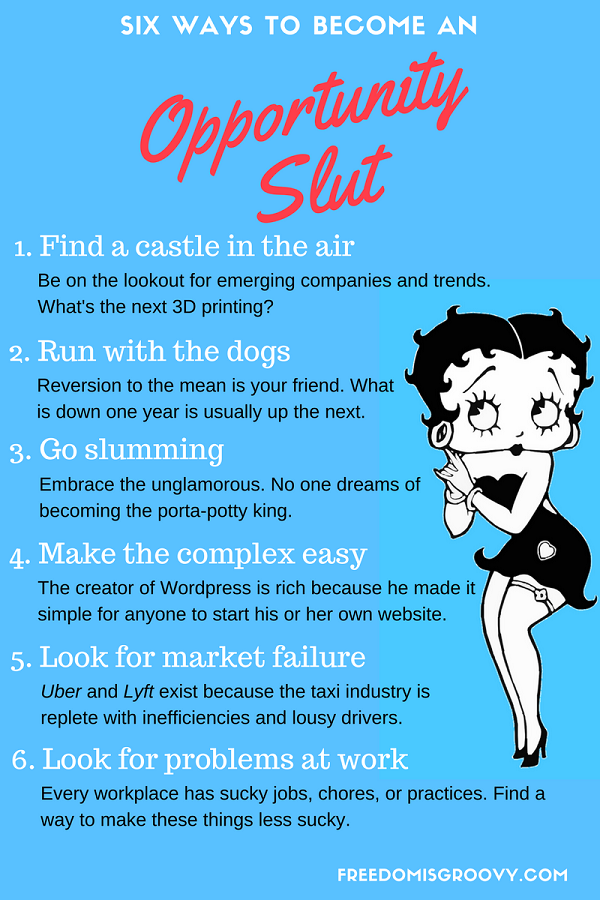
Okay, with the preliminaries out of the way, here are six ways to transform yourself into an opportunity slut.
Find a Castle in the Air
Back in 1984, I read a book called The Spirit of Enterprise. And in this book, the author, George Gilder, mentioned two unknown companies doing some amazing stuff. The companies were Microsoft and Intel.
But because I was an opportunity virgin back then, the idea of capitalizing on my knowledge of Microsoft and Intel never crossed my mind. I didn’t bother to see if either company was trading publicly. Nor did I bother to see if there were any other companies in the software and microchip fields that might present golden investment opportunities. Nope. Here was opportunity giving me a very alluring come-hither look, and I just kept on walking—no doubt singing 99 Luftballons or some other ridiculous song from the early 80s.
Suppose for a moment, though, I kept Microsoft on my radar and bought 50 shares of it when it had its IPO in 1986. Those 50 shares would have cost me $1,050. If I kept those shares for 10 years, those 50 shares would have morphed into 1,800 shares because of splits and the value of those shares would have been about $150K. Ouch.
Thankfully, I didn’t remain an opportunity virgin forever. In 2011, I came across an article in the MIT Technology Review about 3D printing and I was fascinated with the techology. I was sure 3D printing was going to revolutionize manufacturing. So I googled 3D printing companies and discovered a company called 3D Systems. It was trading for around $16 a share. Seeing this, and not wanting to relive my Microsoft and Intel debacle all over again, I then convinced Mrs. G to invest $5K in 3D Systems. This proved to be very fortuitous. 3D printing soon become the technology everyone was talking about. In 2013, 3D Systems was trading for over $80 a share. We sold our stake and turned $5K into $25K.
In his book, A Random Walk Down Wall Street, Burton Malkiel referred to this kind of investing as castle-in-the-air investing. Here are Mr. Malkiel’s exact words:
“The castle-in-the-air theory of investing concentrates on psychic values. John Maynard Keynes, a famous economist and successful investor, enunciated the theory most lucidly in 1936. It was his opinion that professional investors prefer to devote their energies not to estimating intrinsic values, but rather to analyzing how the crowd of investors is likely to behave in the future and how during periods of optimism they tend to build their hopes into castles in the air. The successful investor tries to beat the gun by estimating what investment situations are most susceptible to public castle-building and buying before the crowd.” [Emphasis mine.]
So how do you find and invest in castles in the air?
First, be curious. Read about economics, business, and technology. Two great resources for this are the websites Real Clear Markets and Real Clear Future. And, then, if you come across a castle-in-the-air situation, do the following.
- Bet on one company at a time.
- Bet only what you can afford to lose (no more than 5% of your portfolio).
- Hold your bet for at least a year.
- Sell when your investment has at least doubled.
Run with the Dogs
In February of 2009, Bank of America’s stock price dipped below $4. It was the depths of the Great Recession, and I half jokingly suggested to Mrs. G that we throw $50K at the troubled bank. We didn’t, of course, and we soon regretted it. By July, Bank of America’s stock price was over $17. Had we been opportunity sluts, we would have made an easy $162K.
In 2015, a similar thing happened. Our energy fund, FSENX, was down over 20% for the year. But rather than do nothing, we doubled down on our investment. The result? FSENX was up over 33% in 2016. It pays to be an opportunity slut.
Remember: reversion to the mean is your friend. A stock or a sector that gets killed one year is likely to rebound nicely the following year. So keep your eye open for market dogs.
FSENX Returns in the Year Following an Annual Loss of Ten Percent or More
| Year | Loss | Next Year’s Gain/Loss |
|---|---|---|
| 1982 | -12.16% | 20.27% |
| 1998 | -14.74% | 34.23% |
| 2001 | -11.97% | -11.48% |
| 2002 | -11.48% | 22.87% |
| 2008 | -54.00% | 47.09% |
| 2014 | -12.64% | -20.53% |
| 2015 | -20.53 | 33.84% |
Go Slumming
When I graduated high school in 1979, all of my friends went to college except one. Marco, with the help of his dad, bought a small bread route instead. I think the route had a dozen or so delis and small restaurants. This fledgling business wasn’t very glamorous or fun. He had to start his route every midnight—7 days a week, 365 days a year—so his customers would have fresh bread first thing in the morning. And I distinctly remember how we used to mock him for not being able to hang out all night at the Amber Inn (the Cheers of our youth).
Well, it wasn’t long before Marco was laughing at me and all the other college boys and girls in our social circle. By the time I was a senior in college, Marco had built his bread route up to over 90 customers. And some of these customers were substantial. He provided the bread for at least six airlines at Kennedy Airport. I don’t know what his exact income was at this time, but he was easily making over $100K. And this was in 1983. Want to know what I was making at my first job out of college? I was making the princely sum of $17K.
The lesson of this story is twofold. First, don’t go to college and major in sociology. Second, don’t discount grungy or mundane business opportunities. Marco didn’t grow up dreaming of owning his own bread route. But being a bread man made him his own boss and made him rich.
So if you have an entrepreneurial bent, consider slumming. The best and the brightest aren’t clamoring to deliver bread, cut grass, shingle roofs, kill vermin, clean up murder scenes, and maintain a fleet of porta-potties. This means the competition in these fields is less fierce. You won’t need a high IQ to stand out. All you’ll need is a good work ethic and a strong dedication to customer service. It sounds ridiculous, but there isn’t just poop and pee-pee sloshing around in those porta-potties you happen upon. For some maverick business person, there’s gold.
Hey, groovy freedomists, two days after I published this post, I came across a Mike Rowe clip on YouTube that makes my “go slumming” point far better than I do. So I just had to include it here. Enjoy.
Make the Complex Easy
Because of WordPress, creating an online presence is remarkably easy. In about an hour’s time, you can get your blog or online store up and running. This is why Matt Mullenweg, the creator of the WordPress platform, is a wealthy man. He made the complex easy and helped usher in the era of DIY website administration. The average joe is no longer hostage to webmasters for functional and attractive websites.
Making the complex easy is a surefire way of making money. So look for something that is mind-numbingly complex and figure out how to make it easy for the common man.
Need some ideas? How about helping people figure out their best Social Security claiming strategy. Or how about helping people with their Byzantine medical bills and making sure they haven’t been overcharged or defrauded. Oh, and here’s something else I’d love to see demystified: residential solar power. Ever watch a DIY solar installation on YouTube? The first person who creates an out-of-the-box, plug-n-play system that the average guy or gal can install is going to make a killing.
Look for Market Failure
A while back, I had a business meeting in Minneapolis. It cost me $30 for a cab ride from the airport to the hotel. A co-worker, who traveled from the same airport to the same hotel, was charged $15 for her cab ride. This is why Uber and Lyft exist. The cab industry is so rife with inefficiencies and thievery it’s tailor-made for disruption.
So look for market failure. See what industries aren’t satisfying the needs of their customers and come up with a better business model.
Higher education, for instance, has a miserable business model. The first entrepreneur who can offer a solid education and make the need for student loans obsolete is going to be very rich.
The healthcare business model sucks too. The lack of price transparency and competition is propelling us toward an economic Armageddon. Any entrepreneur who manages to successfully disrupt the current system—say, by mainstreaming medical tourism or scaling a no-insurance business model—is going to do very well for himself.
Look for Problems at Work
One of my proudest moments as a public servant was when I converted the highway department’s street dictionary from a Word document to an Access database. And what makes me proud of this achievement is not that I made something better—although, that certainly plays a role—but that I did it of my own volition. No one told me to make the street dictionary better. I just saw something that wasn’t working and I decided to fix it.
From that point on, I developed a knack for tackling workplace problems and fixing them. Another example of this is when I went to my boss and pitched the idea of an alternate month sweeping schedule. I won’t go into the details now (you can read about here), but suffice it to say that the old way of cleaning the streets wasn’t working and the implementation of my alternate month sweeping idea was a huge improvement. Everybody won—management, the sweeper operators, and the taxpayers.
The point of sharing these stories is not to blow my own horn. The point is to show you that workplace problems are opportunities too. Every workplace has jobs, chores, and practices that are profoundly crappy. Find a way to de-crap them and you’ll be a superstar. Advancement may not come as quickly as you might expect, but believe me, if you’re a problem-solver, you will be rewarded. Bosses love problem-solvers.
Final Thoughts
Don’t fall for the canard that opportunity in America is dead. As long as there are publicly-traded stocks, snobbery, complexity, and problems, there will be oodles of opportunity in America.
Call me a cynic, but I think the opportunity deniers are out to enslave you. And they learned long ago that you don’t enslave modern man with chains. That’s old school tyranny. No, the modern way of enslaving man is to limit his imagination. You tell him over and over again via song, movies, television, schooling, and news that he has no hope of changing his circumstances himself; his only hope for a better life is to surrender to the one or two “saviors” you have chosen for him. And, then, once his mind accepts your constrained options, he’s sunk. He’s a slave.
Don’t let opportunity deniers destroy your mind and keep you an opportunity virgin or turn you into an opportunity prude. Your financial well-being isn’t dependent on the government, on media-approved “leaders,” or on any other “savior” they might come up with. Your financial well-being is dependent on what’s between your ears. So get your mind right. YOU’RE AN AMERICAN, GOD DAMN IT. Your birthright is opportunity.
Proudly proclaim to the world that you’re an opportunity slut, and start financially tupping like there’s no tomorrow.


Leave a Reply to SJ Cancel reply