This post may contain affiliate links. Please read our disclosure for more information.

In the late 1970s, young people in New York used to go to movie theaters at midnight with newspapers and water guns. Yes, that sounds bizarre. But it’s true. What’s even more bizarre is that many of these young people would be dressed up like the two bon vivants pictured below.
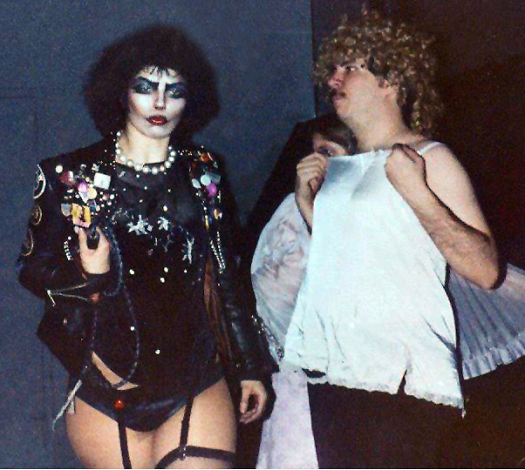
I never understood The Rocky Horror Picture Show craze. But, hey, there’s much from the 70s that leaves me baffled. Pet rocks, mood rings, clogs, streaking, Billy Beer, and Sha Na Na—these are just some of the things that personified the 70s and traumatized my youth.
And millennials think they’ve had it rough!
But I digress. My point here is not to poke fun at millennials. Hasn’t that path been trodden by enough feet already? My point here is to help millennials and anyone else struggling financially.
So getting back on point, I still don’t get The Rocky Horror Picture Show craze. But with age comes a certain degree of wisdom, and I’ve developed a begrudging admiration for the movie’s lead character, the sweet transvestite from Transsexual Transylvania, Dr. Frank N. Furter.
And, no, this begrudging admiration is not because I’m about to let some long simmering desire bubble forth. I will not be known as Caitlyn Groovy going forward.
No, I admire Dr. Furter because he mastered the art of simple, and this mastery has a personal finance angle. Let me explain.
Dr. Frank N. Furter and Personal Finance
In the movie, Dr. Furter is a cult leader with a very intense following. And he got this very intense following because he devised a very cunning dance called the Time Warp. Here it is.
Let’s do the Time Warp again.
It’s just a jump to the left.
And then a step to the right.
With your hand on your hips.
You bring your knees in tight.
Do you see the genius of the Time Warp?
I mean, it’s an incredibly simple dance. A jump to the left and then a step to the right. How freakin’ hard are those moves? Any clod could do it.
And that’s the point. Dr. Furter knew if he could devise a dance with simple moves, the average schnook would be attracted to it. And as the average schnook repeated those simple moves over and over again, he would get sucked in. He would develop a keen sense of accomplishment; he would enjoy the camaraderie of others who knew the dance; and he would be overwhelmed by a sense of loyalty to his new tribe. A cult member would be born.
Improving Your Finances is Just a Jump to the Left
Okay, now for the financial angle.
What happens when you take the lessons learned from Dr. Furter’s Time Warp and apply them to personal finance? You get something I call the Financial Warp—a financial dance so to speak that comprises two simple little moves that any financial clod can master and propels the “dancer” toward the Holy Grail of personal finance: spending less than you earn.
The first move of the Financial Warp, our jump to the left, is any little move that saves you money.
Everyone’s situation is different, of course, so your jump to the left will be different from my jump to the left. Here, for example, are some of the jumps to the left that Mrs. Groovy and I performed when we soured on living paycheck-to-paycheck and began doing the Financial Warp (circa 2003).
When we first began to track our spending, we discovered that we were spending nearly $600 a month on groceries—for two people! It didn’t take much brain power to quickly reduce that bill to $350-$400 a month. More pasta, more store-brands, and more coupons equaled more savings. And with really no impact on the quality of our lives. In fact, I found a $2.99 bottle of blackberry merlot that blew away the $10-12 bottles of wine I had normally purchased.
We got rid of premium cable channels. Goodbye Sex in the City and New York Islanders. The mating habits of four New York City women and the lamentable outcomes of Islander games were becoming boring anyway.
We stopped exchanging gifts. No gifts for Christmas, Hanukkah, Valentine’s Day, our birthdays, and even our anniversary. Exchanging gifts just didn’t make sense. We didn’t have separate financial lives. We commingled our incomes. If I bought a gift for Mrs. Groovy, I would be using some of her money to do so. And likewise for her. This doesn’t mean we were any less romantic. We made our own greeting cards and went to White Castle every Valentine’s Day. And believe me, hand-made greeting cards and dinners at White Castle are the embodiment of romance. They’re great memories too.
Instead of meeting family and friends in bars and restaurants, we took turns hosting The Poverty Tour as we dubbed it and confined our confabs to our homes. BYOB and takeout pizza proved to be about one-fifth the cost of the typical bar or restaurant tab—and just as much fun.
And then a Step to the Right…
Spending less than you earn is not merely about keeping a lid on your spending. It’s also about increasing your household income. So the second move of the Financial Warp, our step to the right, is any little move that boosts your income and gives you more money to save and invest. Here are some steps to the right that Mrs. Groovy and I made when we started doing the Financial Warp.
Not too long after we were married, Mrs. Groovy took a job for a small non-profit in Manhattan. Take away the extra commuting costs, and the Manhattan job was about as remunerative as her Long Island job. But Mrs. Groovy wanted to work in the non-profit world and Manhattan was the epicenter of that world. Long Island wasn’t. She thus made this lateral move to get herself in the game. And sure enough, within a couple years she got a gig at a larger non-profit and doubled her salary.
I got a part-time job at a warehouse. It wasn’t fun, moving product from the racks to the tractor-trailers was work, but surrendering a couple of nights during the week gave us an extra $600 a month after taxes.
At my government job, some of my co-workers had landscaping businesses. And every once in a while they would find themselves shorthanded. I’d fill in when I was up for a workout and the four to five hours of cutting grass would put an extra $60-$80 tax-free cash in my pocket.
Government is very liberal when it comes to fringe benefits. I got 13 sick days and 5 personal days every year. Unused sick and personal days, in turn, weren’t lost; they were banked. And when you left the government, you got paid for all the unused time you banked. So in 2003, I vowed not to take another sick or personal day again—unless I was truly sick, of course. And because the ensuing three-plus years proved to be especially healthy (I used one sick day), I left my government job with an additional $18K in banked time.
Final Thoughts
Before Mrs. Groovy and I started doing the Financial Warp, we were everyday Americans. We had debt up to our eyeballs and we were living paycheck to paycheck. But then we started doing those little jumps to the left and those little steps to the right. And we did a lot of them. By the time we abandoned Long Island for Charlotte, NC, in 2006, we were saving $2,000 a month.
And, again, the beautiful thing about the Financial Warp is that it was easy. We didn’t do anything spectacular. We just used our functioning brains to ferret out any reasonable way for us to spend less or earn more.
Okay, groovy freedomists, that’s all I got. A while back, I said the personal finance community has a lot to learn from a man who eats human flesh. Now I say the personal finance community has a lot to learn from a man who wears fish-net stockings and has a very fluid sexual identity. Am I losing it? Or have I found a clever way to make spending less than you earn a little edgy, a little—dare I say—deviant?
Oh, and one more question. If the Financial Warp is a legitimate thing, who’s the sweet transvestite of our twisted financial cult? Dave Ramsey? Mr. Money Mustache? J Money?
Let me know what you think when you get a chance. I’d love to hear your feedback. Grease for peace.
P.S. Mrs. Groovy and I were interviewed by The Green Swan recently. Check it out here.


Leave a Reply to Kate Cancel reply