
This post may contain affiliate links. Please read our disclosure for more information.

Last Wednesday, I published Part One of my two-part series, “Ten Reasons Why You Can’t Save Money.” Here’s Part Two.
Reasons Six to Ten Why You Can’t Save
Six: You Don’t Listen to Dave Ramsey
Haha! Only kidding. Mr. Ramsey is being used here as a metaphor, although his syndicated radio show is surely worth your time. No, in order to save money, you got to shift from a consumption mindset to a saving mindset. And that transformation is best accomplished by immersing yourself in the personal finance community. Just devote an hour a day to honing your financial acumen and within a year, you’ll find yourself with some pretty formidable saving muscles.
Here are some books, blogs, podcasts, and YouTube channels to get you started.
Books
Blogs
Blog Post
- Thanks to Mr. Grumby (see his comment below), I decided to edit my personal finance suggestions. If you only read one post from a personal finance blog in your lifetime, it has to be Mr. Money Mustache’s “The Shockingly Simple Math Behind Early Retirement.” This post has radically changed the personal finance perspectives of thousands of people, including me and Mr. Grumby. Please do yourself a favor and read it.
Podcasts
YouTube
Seven: You Don’t Own Your Home Outright
From 2006 to 2016, Mrs. Groovy and I saved roughly 50 percent of our household income annually. And we achieved this prodigious savings rate without resorting to a threadbare existence. We lived in a nice 2,000 square foot home in a nice neighborhood, we drove nice cars, we ate out whenever we wanted, we gave generously, and we traveled extensively, visiting over 20 states and Italy.
What was our secret? Starting in 2006, we owned our home outright. And your cost of living is incredibly low when you own your home outright. In 2016, for instance, our last year of gainful employment before retirement, our housing cost for the year was a little less than $4,500. (This cost consisted of property taxes, HOA, and insurance.) Since our household income in 2016 was $123,000, this meant only 3.66 percent of our income was devoted to housing. That minuscule housing cost, in turn, freed up a lot of money to live nicely—and SAVE!
If you want to save money—particularly, a lot of money—find a way to own your home outright. Here are some suggestions:
Go small. Your bed doesn’t care where it’s situated. Nor does your laptop, television, sofa, water heater, furnace, air conditioner, oven, refrigerator, toilet, and shower. They’ll all provide the same level of comfort or utility whether they’re situated in a 3,000 square foot McMansion or a 900 square foot cottage.
Go tiny. Living in a 200-square-foot house on wheels isn’t for everybody. But it’s a great way to own your housing outright, enjoy all the amenities of conventional housing, and save a ton of money. Check out these great examples of tiny-home living here, here, and here.
Go unconventional. Who said a comfortable home has to be made out of two-by-fours and sit on a concrete foundation? A comfortable home could just as easily be a van, a school bus, a tent, a shipping container, or an RV.
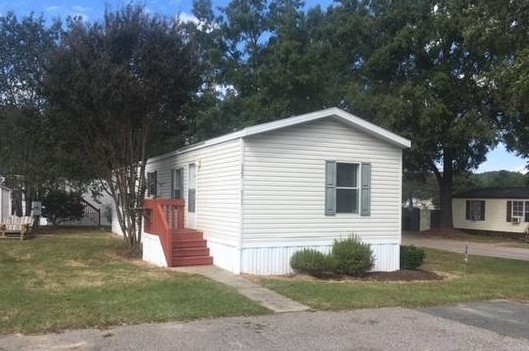
Go rogue. And by rogue, I mean the dreaded trailer. If you live in a trailer, a lot of people will look down upon you. But that snobbery stems less from the quality of mobile homes—mobile homes are perfectly fine housing—and more from the quality of people who tend to inhabit mobile homes. Sadly, mobile homes are often the only housing option available to those who have partied, slept, or fornicated themselves into financial oblivion. But if you can handle the slings and arrows of outrageous classism, trailers are a great way to own your home outright and free up a lot of money for saving. Check out this trailer in Raleigh that I just saw on Craigslist being sold for $40,000. Again, not the greatest housing. But it’s perfectly adequate and a lot easier to own outright than a conventional home.
Go rural. A home costing less than $500,000 in my old Long Island neighborhood would be very difficult to find. You can, however, easily find a decent home in my new North Carolina neighborhood for less than $200,000. Living in rural America isn’t for everyone, of course. But if it fits your temperament, and you can still make a decent amount of money, it’s a much easier path to outright homeownership than living in a big city.
Eight: You Aren’t Married
In 2003, my income was $24,000 larger than my 2002 income. In 2006, my income was $66,000 larger than my 2002 income.
How did I make such tremendous strides on the income front? Raises surely played a part. The biggest reason, however, was that I took advantage of something that human beings have been doing for thousands of years to mitigate economic scarcity and tackle big hairy audacious goals. Yep, I got married. And once Mrs. Groovy finished grad school and moved from part-time work to full-time work, my household income rose significantly.
Marriage, of course, shouldn’t be taken lightly. If you choose the wrong partner, and things get ugly, getting married could become the worst decision of your life. But if you choose the right partner, and you and your partner dedicate yourselves to saving money and building wealth, getting married will very likely become the best decision of your life.
Never forget: You’ll have a far easier time earning money and saving money if you have four hands, two brains, and two incomes devoted to those goals than two hands, one brain, and one income.
Nine: You Never Tried
If you think the federal government is wasteful, just record all of your spending for a month. You’ll likely discover that you’re just as profligate.
This was certainly the case for me and Mrs. Groovy. Once we began to track our spending back in 2003, we quickly realized that we could maintain our quality of life with 15 percent less spending. In just a few months, our spending went from $4,500 a month to $3,800 a month. And because we were taking home $4,500 a month at the time, our monthly savings went from $0 to $700.
Americans are great at figuring things out. They’re not so great at figuring out that figuring out how to save needs to be a top priority.
If you have a problem saving money, it’s more than likely because you never tried.
Stop being aimless with your finances. Work and spend with a purpose. Give yourself a saving bullseye of, say, five or ten percent of your take-home pay, and aim for it. You won’t hit your bullseye overnight. But if you do the below three things, you’ll figure out how to hit your bullseye soon enough.
- Track your spending, preferably by categories (e.g., rent, food, gas, etc.) and with the aid of a spreadsheet.
- Use the internet to learn how to be frugal.
- Focus your saving efforts on the big three expenses—housing, transportation, and food.
Ten: You Never Understood the Importance of Saving
A big reason why I was such a lame-ass saver until my 40s was because I never understood the importance of saving. No one ever explained to me that saving builds wealth and wealth provides intangible benefits that greatly enhance one’s quality of life and one’s self-respect.
Before I point out those intangible benefits, however, I want you to consider where Mrs. Groovy and I were financially after saving prodigiously for five years:
- We were completely debt free
- We had a two-year emergency fund
- And we had an investment portfolio that was more than ten times larger than our annual expenses
And now here are the intangible benefits that I alluded to:
- Goodbye worries. When you have enough money sitting in the bank to cover just about any emergency—whether it’s a trip to the emergency room or a blown transmission—sleepless nights are no longer a part of your life.
- Goodbye ass-kissing. The more I saved and the wealthier I got, the more I refrained from toady-like behavior at work. By the time I reached the above level of financial security, I simply stopped worrying about my job. In other words, because I had solid job skills, and because I had a very sturdy financial foundation, I no longer feared downsizing, outsourcing, and being passed over for a bonus or a promotion. Accordingly, I stopped saying “yes” to things that interfered with my primary responsibilities, stopped sugar-coating my thoughts when someone asked me for my work-related opinion, and stopped basing my workplace friendships on who might better help me advance my career (i.e., I hobnobbed far more with the scum than the mucky-mucks). And the funny thing is, not caring and being true to myself didn’t hurt me. I still got my fair share of raises, promotions, bonuses, and admiration.
- Goodbye unethical behavior. This is definitely grist for another post, but before I gained the above level of financial security, I did a number of unethical things to increase my income. Nothing illegal or immoral, mind you, but things that nonetheless reflected poorly on my character. The good news, however, is that once I got my financial act together, and once Mrs. Groovy and I started building wealth, I no longer felt compelled to ignore my conscience. Wealth gave me the power and confidence to lead a much more honorable life.
The lesson couldn’t be clearer. If you want to remove stress from your life and be a better person, save, save, save.
Final Thoughts
Okay, groovy freedomist, that’s all I got. What say you? Is this a great top-ten list that nails the reasons why the typical American can’t save? Or is this another pedestrian list from a pedestrian blogger that needs to be ignored with extreme prejudice? Let me know what you think when you get a chance. Peace.


Leave a Reply to steve poling Cancel reply