This post may contain affiliate links. Please read our disclosure for more information.

Warning: If you have a delicate constitution, you will likely be offended by what follows. I offer no apologies. It is MY manifesto, after all. If you disagree, I look forward to reading YOUR manifesto, and I will respectfully listen to YOUR views. I’m simply asking that you respectfully listen to mine. This is America—the last bastion of free speech on earth—and there’s no reason why areas of contention can’t be discussed intelligently and affably. Just because they’re buttheads on Fox News and MSNBC doesn’t mean we have to be. With that, I’m taking the plunge…
In my book, The Groovy Guide to Financial Independence, I warn readers at the start of the final chapter (Chapter Ten) that they’re about to encounter some “alt-FI bullshit.” But I never explicitly state what the definition of alt-FI is. This post was written to correct that oversight.
Alt-FI and Mainstream FI Defined
Alt-FI stands for alt-financial independence, and it’s a take-off on the political monikers, alt-right and alt-left. Alt-right people and alt-left people, in turn, are considered fringe people. Alt-right people are righties who reject mainstream conservatism and alt-left people are lefties who reject mainstream liberalism. Does this then mean that alt-FI people reject the mainstream financial strategies promulgated by the FI community? No. But alt-FI people do differ from mainstream FI people on a number of key issues.
Before I get to those key issues, though, I think it’s important to provide some back-of-the-envelope definitions for both alt-FI and mainstream FI.
Alt-FI people are people who champion the pillars of financial independence from a libertarian or freedomist perspective. Mainstream FI people, on the other hand, are people who champion the pillars of financial independence from a socialist or collectivist perspective—especially as it relates to the safety net, higher education, and healthcare. As far as I can tell, mainstream FI people far outnumber alt-FI people (that’s why I’m calling them “mainstream” FI people). In fact, I think I’m the only official member of the alt-FI community. Perhaps there are alt-FI people out there who just don’t know they’re alt-FI. We’ll see.
Okay, with the back-of-the-envelope definitions of alt-FI and mainstream FI out of the way, let’s see how these worldviews differ on some key issues.
Quick aside. No one, that I’m aware of, has actually codified “mainstream FI thoughts.” So when I label something a mainstream FI thought, I’m talking out of a certain orifice that I probably shouldn’t be talking out of. But I have been a member of the FI community for over three years now, and I think I have a good grasp of what this community generally believes, and what the most influential thought-shapers in this community generally believe. Should I err in my description of a mainstream FI thought, however, I implore you to digitally smack me upside my head. As always, my objective here is not to “win.” It’s more important to me to get it right than to be right.
The Definition of Privilege
To alt-FI people, privilege is lawful preferential treatment given by those in charge of an institution or a government entity to some of the people they employ, recruit, or serve. In other words, privilege is when the cool people frown on unfettered competition and say it’s okay to give some people a leg up at the expense of others. “All animals are equal, but some animals are more equal than others.”
A good example of this is the physical requirements needed to join the Marines. In order to join the Marines, recruits must pass an initial strength test (IST). For men, passing the IST requires doing two pull-ups. For women, passing the IST requires hanging on a pull-up bar for 12 seconds (i.e., zero pull-ups).
Another good example of privilege is the test scores needed to enter our elite colleges. Not one elite college in the country requires black and Hispanic applicants to meet or exceed the SAT scores of their white and Asian counterparts. In one study, for instance, black skin was worth 310 SAT points. Hispanic heritage was worth 130 SAT points. And in another study, it was found that if Harvard based admissions solely on academics, Asians would go from 19 percent of the typical freshman class to 43 percent.
Mainstream FI people wouldn’t describe the above examples of clear cut preferential treatment as female privilege or black and Hispanic privilege. No, the mainstream FI definition of privilege is much more nebulous. From what I can gather, it seems to mean having more cultural, financial, or human capital than others. That’s it. It doesn’t matter if that superior cultural, financial, or human capital was acquired justly, and it doesn’t matter if the tools and attitudes necessary to build cultural, financial, or human capital are free for everyone to use or mimic. If you grew up in a two-parent household, with parents who made middle-class incomes or better, and who passed along virtues and attitudes that were conducive to gaining worthwhile skills and building wealth, your success, should you have any, really isn’t valid. You’re kind of a cheater. And unless you acknowledge your “privilege,” and continually flagellate yourself over it, any advice you have for those struggling financially is damn near worthless.
What I Don’t Like About the Mainstream FI Definition of Privilege
Most mainstream FI people mistakenly use the word privilege as a synonym for good fortune or luck. And they use it because, quite frankly, good fortune and luck are part of most if not all individual FI narratives, and acknowledging the role that good fortune and luck play is an important part of being intellectually honest. But there’s also an ugly side to how the word privilege is used by some mainstream FI people. Here, then, is a review of that ugly side.
It’s Too Often Used as a Smear
It’s one thing to recount your good fortune or luck and label it “privilege.” I don’t like it, I think it’s an abuse of language, but at least the abuse of language is being directed at yourself. It’s quite another thing entirely to point the steely finger of indignation at another person—a person you really know nothing about, I may add—and accuse him or her of having “privilege.” Why? Because in that situation, it’s not being used to further anyone’s understanding of anything. It’s being used as a smear.
All too often, those who hurl the term “privilege” at others are effectively saying, “I don’t like what you said, I can’t refute you intellectually, so I’ll just accuse you of having a trait that most people have been conditioned to find objectionable.”
The Smear Component Is Only Used Selectively
The social acceptability of men hitting men is far more widespread than the social acceptability of men hitting women (thank God). Women dominate several well-paying professions, including public relations, nursing, teaching, veterinary medicine, and gynecology. Women also do better than men in school and are far less likely than men to be incarcerated, homeless, suicidal, injured at work, or killed in battle. And, yet, I never hear the term “female privilege” being bandied about.
Likewise, Asian-Americans are the most successful ethnic group in America by a considerable margin. Simply put, Asian-Americans are kicking ass academically and financially. And, yet, I never hear the term “Asian privilege” being bandied about.
I do, however, hear the terms “male privilege” and “white privilege” being bandied about a lot. Why? It seems that every group in America has some degree of privilege if privilege simply means having more than other groups or doing better than other groups. Hispanics certainly have “privilege” when it comes to immigration. Blacks certainly have “privilege” when it comes to athletic prowess. Why do mainstream FI people only have a preoccupation for certain examples of privilege? Why do mainstream FI people only expect people from certain groups to admit their “unfair advantages” and flagellate themselves publicly?
It’s Intellectually Lazy
How does requiring certain people with “privilege” to publicly flagellate themselves over their “unfair advantages” help those without “privilege?” In other words, how does the gnashing of your teeth over your fine, middle-class upbringing help those who grew up in single-parent households and had to deal with less than stellar schools and neighbors? I suppose it might help if this demeaning self-flagellation ritual led to more effective laws and policies. But exactly what laws and policies are currently forcing poor young girls to have children they can’t afford—a significant factor in the perpetuation of poverty? What laws and policies are currently forcing poor children to take the free education they’re provided for granted—again, a significant factor in the perpetuation of poverty?
My biggest gripe with the mainstream FI definition of privilege is that it’s intellectually lazy. Too many mainstream FI people believe that one’s starting position in life is automatically one’s ending position. “Non-privilege begets non-privilege” and “privilege begets privilege.” In other words, too many mainstream FI people have too little regard for human agency. They believe that those born with less will forever have less and it’s unbelievably cruel to hold the have-nots accountable for any part of their lamentable circumstances. Likewise, those born with more will forever have more and it’s unbelievably foolish to give the haves any credit for any success they may achieve. Everything is fixed. The Gini coefficient is as immutable as the law of gravity. Human agency means squat.
But are these notions valid? Is it really cruel to hold the have-nots accountable for any part of their lamentable circumstances? And is it really foolish to give the haves any credit for any success they may achieve?
Perpetuating Financial Moronity
I obviously think it’s not on both accounts. First, let’s look at the notion that “non-privilege begets non-privilege” and it’s cruel to hold the have-nots accountable for any part of their lamentable circumstances. Consider the following scenario:
You come across a dyed-in-the-wool white supremacist. This loathsome individual is your new co-worker or neighbor. But after interacting with this loathsome individual for a little while, you come to learn that he inherited some pretty awful broken moral windows while growing up. His parents were inveterate racists, and so were all his kin, friends, and neighbors. You also come to learn that this loathsome individual would be disowned by his entire family if he ever renounced any part of his white supremacist upbringing. His family doesn’t suffer “traitors” under any circumstances.
Here’s a question for you. Would you give this white supremacist a pass? I mean, after all, it wasn’t his fault he was born into a racist family. So how can you hold him accountable for any of his racist views?
I could be wrong, but I doubt you would be willing to give our white supremacist a pass, especially if you’re from the SJW wing of the mainstream FI community. You may not expect him to purge his racist views overnight and become the next Gandhi or Martin Luther King, Jr., but you’d expect him to embrace a more tolerant worldview. And you wouldn’t make any excuses for him if he failed to fix his most glaring broken moral windows and passed those broken moral windows onto his children.
Now let’s flip the switch. Let’s substitute broken financial windows for broken moral windows. Our damaged individual isn’t a white supremacist, he’s a financial moron. And he’s a financial moron largely because he inherited some pretty awful broken financial windows from his have-not family, friends, and neighbors. Do you give this fellow a pass for his moronic financial behaviors? And if so, why? Why is the moral have-not held accountable for his failures and not the financial have-not? Why do you expect the moral have-not to change his ways but not the financial have-not?
This is why I find the notion that “non-privilege begets non-privilege” to be intellectually lazy. It’s not considering the ultimate ramifications of giving the financial have-nots a pass. In effect, by not holding the have-nots accountable—by telling them it’s okay to leave their broken financial windows broken—mainstream FI people are subsidizing financial moronity. And whatever you subsidize, you get more of. The end result is multi-generational financial moronity. Broken financial windows are never fixed. Young girls and women who are too broke to have kids have kids. Children who can least afford to take education for granted take education for granted. And there sit the cool people—the politicians, the activists, the do-gooders, and the mainstream FI-ers who are always ready to comfort the have-nots. “It’s not your fault, have-nots. It’s the fault of systemic racism and sexism and the evil one percent.”
And the cool people have all the facts and studies to prove it.
And so the circle of financial moronity spins round and round, year after dreary year. When did LBJ declare war on poverty, by the way?
Quick aside. For a jarring look at the circle of financial moronity in action, check out this article from Quillette.
Hail Those with More Who Maintain or Create More
Now let’s turn to the second reason why I find the mainstream FI understanding of privilege to be intellectually lazy—the notion that “privilege begets privilege” and the privileged don’t deserve any credit for maintaining or advancing their so-called advantages.
Here’s an experiment for you. Stop showering. And while you’re at it, stop brushing your teeth, shaving, and performing any other grooming activity you do on a regular basis. How many days will it take before you become a social pariah, an unsightly hirsute walking stink bomb?
The unavoidable law of entropy afflicts all bodies—from the camera and scale challenged, all the way up to the most “privileged” examples of the human form imaginable.
And the unavoidable law of entropy doesn’t just affect the body. It affects all things under the sun, including “privilege.” Case in point. I have a friend who grew up with a lot more than I did. His father was a furrier who made fur coats for the biggest retailers in the New York City fur scene (hey, does any New York reader remember Fred the Furrier?). Needless to say, his father did very well for himself. After high school, my friend and his brother started working full time in their father’s fur business. And they began to do very well for themselves as well. But then tragedy struck. My friend’s father died suddenly from a heart attack. The successful fur business his dad had labored mightily to create was now his and his brother’s sole responsibility.
To their credit, my friend and his brother did an admirable job keeping the fur business humming along. Workers, suppliers, landlords, and bankers were being paid, clients were being satisfied, and profits were being made. But then, as the 90s appeared on the horizon, tragedy, so to speak, struck again. In the 60s and 70s, fur coats had a lot of social cachet. In fact, I distinctly remember contestants and audience members swooning whenever a fur coat was a potential prize on a game show. By the mid to late 80s, however, that began to change. The cool people, especially those in entertainment and fashion, began to recognize the unseemliness of the fur business (it’s hard to put a happy face on the clubbing of baby seals). By the time the 90s arrived, the rout was on. The fur business was in irreversible decline (in the United States, anyway).
But my friend and his brother adjusted. They both moved to Dallas and transitioned to the swimming apparel business. This transition, in turn, wasn’t easy. Both my friend and his brother worked their asses off. Today, they are as successful as ever. And, yet, despite nearly forty years of intense toil, they’re still toiling away. My friend also started a real estate side hustle. Between his swimming apparel business and his real estate ventures, he’s working 12 hours a day, six days a week.
Entropy is real—especially in business and personal finance. Those with more don’t get to coast. More isn’t a guarantee. More without the proper attention quickly becomes less. Those with more who maintain or grow that more in an honorable fashion deserve our admiration, not snarky dismissal. And those in the mainstream FI community who think otherwise, who think it’s okay to hate on anyone “born on third base,” are exhibiting a considerable degree of intellectual laziness.
Worshiping at the Altar of Diversity
Alt-FI people don’t worship at the altar of diversity. This means they don’t dismiss outright or automatically judge inferior those things that lack diversity. For instance, the NBA and the NFL are both overwhelmingly black and one hundred percent male. And this is perfectly fine. The NBA and the NFL don’t need to look more like America. The lack of whites, Hispanics, Asians, and women doesn’t make the entertainment value of the two sports any less compelling. As long as the NBA and the NFL aren’t discriminating—which is categorically the case—the fans really shouldn’t give a rat’s ass what skin color and what plumbing the players have. If the players skew a certain color and gender, so be it.
Likewise, alt-FI people don’t dismiss outright or automatically judge inferior any FI-related things that lack diversity. Take a look at a recent group photo from a meet-up that Gwen from Fiery Millennials posted on her blog.
Update: Oh, man, did I step on some religious toes—civic religious toes, that is. And I completely understand the vitriol. You don’t challenge the status quo and expect to go unscathed. But that’s what free speech is all about. All’s fair in love, war, and blogging. And I wouldn’t have it any other way. Those who dislike this post have a duty to say so. Gwen is one such blogger who vehemently opposes this post. I think her reasons are wrong, but that’s another matter. She doesn’t want me to use the picture of the meet-up that appeared on her post, and that’s all that counts. Gwen is a good person, and I have no problem honoring her wishes. I have thus removed the picture of the meet-up from this post. For context, you can head over to Gwen’s website to see it. Anyway, the picture of the meet-up shows a lot of smiling white faces.
There’s a lot of whiteness in that photo. And there’s nothing wrong with that, providing, of course, that the meet-up organizers didn’t discriminate. Since I’m confident that discrimination played no role in the demographics of this meet-up, I’m sure it was a very worthwhile affair, and I’m jealous I wasn’t there. And I would feel the exact same way if this photo contained a lot of Hispanic-ness, or a lot of gay-ness, or a lot of Asian-ness. Alt-FI people simply don’t give a shit about diversity. They believe that concerning oneself with the demographics of a meet-up or conference is as inappropriate and ridiculous as concerning oneself with the jean allocation of a meet-up or conference (“Oh, no, too many people are wearing Levi’s”).
Mainstream FI people, on the other hand, are diversity mongers and are very uncomfortable when anything in the FI community lacks diversity. They see a meet-up like the one above and they either cringe or lament. “It’s too white!” And they all agree that “something needs to be done about it.”
When I was growing up, our elites were very big on “brotherly love” and a “colorblind society.” And I remember my elementary and junior high school teachers continually telling me and my classmates that “we’re all the same under the skin.”
I’m not a fan of our current elites. They’re much too anti-freedom for my taste. In fact, when it comes to their list of concerns and priorities, I don’t think freedom even makes the list. But that’s a matter for one of the twisted books I’m working on. I only mention this to show that I’m not a slave to whatever received wisdom is passed down to the benighted. If our elites get it wrong, I say so. Likewise, if our elites get something right, I salute them. And our elites from the 60s and 70s got it right when they championed a colorblind society. The dream of a colorblind society, where we’re only judged by “the content of our character,” is one of the noblest aspirations I can think of.
Each of us has a choice. We can condition ourselves to be colorblind or color-aware. Alt-FI people believe we move closer to a “more perfect union” by being colorblind, ethnicity-blind, gender-blind, sexual orientation-blind, and “whatever irrelevant trait you can think of”-blind. Mainstream FI people, on the other hand, believe we move closer to a “more perfect union” by being color-aware and encouraging everyone to be obsessive bean counters.
Believing There’s a Right Kind of Tribalism
Alt-FI people are very uncomfortable with tribalism. I am, for instance, a white heterosexual man with blue eyes. But my blog isn’t a financial blog for white people. Nor is it a financial blog for heterosexuals, or for men, or for people with blue eyes. My blog is for anyone trying to de-moronify his or her financial life. I tackle FI-related issues that transcend the accidents of our births.
But what if I were tribal? What if I believed there was a Caucasian way of doing personal finance that wasn’t applicable to non-Caucasians? What if I believed there was a male way of doing personal finance and put together a male-only meet-up or conference? What if I showed up to this year’s FinCon and started handing out MA$CULINI$T t-shirts? Would I be embraced by mainstream FI people? Would I be heralded by mainstream FI people for my heroic voice? Or will I get punched in the face—literally—by the SJW wing of mainstream FI?
I’m not saying, of course, that some FI-related issues don’t affect one tribe more than another. Meekness at work may affect more women than men. But meekness at work isn’t a “woman’s issue.” It’s a meek person’s issue. There are plenty of men out there who don’t stand up for themselves at work and get taken advantage of by management.
Tribalism no doubt became part of the human condition because that’s the way early humans succeeded in fostering the cooperation necessary to ward off hunger and predators. But tribalism came with some pretty nasty side-effects, especially as it related to trust and treatment. You trusted your tribe but not others. You treated members of your tribe one way but members of another tribe a different way.
Because of its nasty side-effects, tribalism is not something to trifle with. We need to look no further than our recent history to see proof of that. I was born in 1961. At that time, Jim Crow segregation was still a prime feature of the American south.
Alt-FI people thus believe you subdue the nasty side-effects of tribalism by frowning on tribalism and keeping tribalism out of the FI community. There’s no Caucasian way of doing FI, and there’s no black, gay, or woman’s way of doing FI either.
Mainstream FI people believe you subdue the nasty side-effects of tribalism by encouraging the “right kind” of tribalism in the FI community (i.e. tribalism for the tribes they like but not for the tribes they don’t like). In other words, mainstream FI people believe they can handle the explosive nature of tribalism better than other groups, countries, or civilizations. Is this hubris? I think so. But until mainstream FI people have a more humble opinion of their cognitive abilities, there will be a black, gay, and woman’s way of doing personal finance in the FI community.
Quick aside. I’m very torn by this stance. On the one hand, I abhor tribalism. I think it’s going to be the ruination of this country. But on the other hand, there are two bloggers who I truly admire and respect—hello Amy and Vicki—who do engage in tribalism. And their website, Women Who Money, is awesome. Heck, Mrs. Groovy and I have even sponsored WWM. So is tribalism based on gender okay? And if it is, can we avoid the slippery slope to full-blown tribalism, where every conceivable tribe tribals-up as a form of self-defense? Damn, this ethics stuff is hard. Hey, Amy and Vicki, can you help me out here and be a little less tribal? Can you change the name of your website to People Who Happen to Be Women and Who Happen to Money?
Believing that You Have a Constitutional Right to Live Off of Others
Alt-FI people don’t believe they have a constitutional right to live off of their fellow Americans. In other words, they don’t believe they’re entitled to “free” healthcare, “free” college, “free” daycare, or “free” anything. They understand the need for a safety net, and they welcome it. Alt-FI people just don’t believe the government should be giving a blank check to help the needy, especially when “the needy” are so often members of the middle and upper classes. Giving the government a blank check to help the needy is a recipe for destroying paycheck freedom (more about this later).
Mainstream FI people, on the other hand, want more “free” stuff, especially “free” healthcare. And they seemingly don’t have any concerns about giving the government a blank check to help the needy.
“Oh, well, the feds lowered the eligibility requirements for nutrition assistance. Now there are twice as many people entitled to SNAP and the poor taxpayers will just have to do with less. Boo hoo.”
“So what if most of what you’re taught in college is neither useful, needed, nor remembered. Every American is entitled to a college education, especially every poor American. And if that means the taxpayers take it up the wazoo, too bad. Suck it up, you greedy philistines.”
“I don’t care if we have porous borders. And I don’t care if our national debt is over $22 trillion. Every American and every person who steps foot on our soil is entitled to free healthcare. Sure there’s a possibility that ‘Medicare for all’ will overwhelm our healthcare system and bankrupt the country. But I’m willing to take that chance.”
Quick aside. Sorry for being so snarky. I never claimed that every one of my alt-FI tendencies was entirely noble. This is actually the primary reason I truly admire mainstream FI people. Mainstream FI people don’t want more government because they hate freedom or taxpayers. They want more government because they hate suffering and squalor. I would counter, of course, that more government isn’t the answer. We have more government help, subsidies, and welfare than ever before and the American people have never been more weak, helpless, and dependent. But that’s a subject for another post. The point here is that mainstream FI people are genuinely caring people and the FI community would be a soulless cult without their tender mercies.
Believing that the FI Community’s Core Financial Tenets Always Have to Be Qualified
Alt-FI people aren’t big on “buts” or “qualifications” when it comes to making FI points. They believe that the FI community’s core financial tenets—better known as the pillars of FI—will work for every inhabitant of the United States, and it’s their job to show how they’ve used these core financial tenets to improve their respective financial lives. It’s not their job to provide a user guide for every financial tenet that is applicable to every inhabitant of the United States.
Case in point. Mr. Money Mustache’s jihad against the automobile.
Mr. Money Mustache is not a car guy. In fact, I would go so far as to say he hates cars. His anti-car bias, in turn, isn’t without cause. Cars befoul our air with a lot of nasty chemicals, and cars cost a lot of money to own and operate. In one particularly eye-opening post, our friends over at Nerdwallet estimate that a new car could easily cost $8,500 a year to own and operate when you factor in all the costs, including depreciation. Because of numbers like that, Mr. Money Mustache believes the typical American should ditch his or her “clown” car, move close to work, and use a bicycle to commute and run errands.
Now, as an alt-FI person, I don’t need Mr. Money Mustache to qualify his car position. He doesn’t have to tell me that not everyone has his “privilege” and can use a bicycle to commute about town and fetch groceries. I know his strategy for mitigating his car expenses won’t work for everybody, especially me. But his FI point about a car being a supreme drag on the typical American’s finances is beyond reproach. And since I’m a typical American, that’s all I really have to know. It’s up to me to figure out how to mitigate my car expenses given my particular circumstances.
Quick aside. I can’t mitigate my car expenses by getting rid of my car. Life without a car in rural North Carolina would be extremely difficult. So I mitigate my car expenses the millionaire-next-door way—by never buying new, never financing, and never failing to run my new-to-me car into the ground. I bought my 2004 Camry in 2008, and “Lucy,” as I call her, is still running fine at 185,000 miles. My goal is to take her to 2021 or 200,000 miles, whichever comes first. Then Mrs. Groovy and I will buy another new-to-us car that’s three to four years old—with cash.
Mainstream FI people, however, are very big on “buts” or “qualifications” when making FI points. Apparently, they have a very dim view of their readership’s critical thinking skills. And if “buts” and “qualifications” aren’t provided, they believe their readership will become confused, detached, and angered.
“Oh, man, I thought this 30-something dude and his 30-something wife were pretty cool. They blog about how they retired early. But then I found out they both had high-paying tech jobs. And they don’t have kids. They have dogs. And get this, they sold their homes and practically all their stuff, and they now live in an Airstream. But how does that help me? I don’t have a high-paying tech job. I work at 7-Eleven. And I can’t live in an Airstream. Where am I going to put all my stuff? Man, this 30-something dude and his 30-something wife turned out to be pretty bogus.”
Or maybe the “buts” and “qualifications” have nothing to do with having a dim view of their readership’s critical thinking skills and everything to do with their need to strut their moral plumage (i.e., virtue signaling)?
I’m not an X-Man, of course. I can’t read minds. So I don’t know exactly what’s driving this degree of pettiness, and it’s unfair of me to speculate. All I know is that a considerable number of mainstream FI people have a penchant for acting like bored prosecutors in a jurisdiction with little crime. And what do bored prosecutors do when there’s too little crime? They manufacture crime. “How dare you fail to inform your readers that your way of mitigating housing costs won’t work for someone who was raised by a crackhead mother, has no skills, and has no ambition beyond getting high and getting laid! How insensitive and disrespectful can you be?!!”
Other Peculiarities of Alt-FI People
As you can tell from the above belief system, alt-FI people are a weird lot. But the weirdness doesn’t end there. Here are four more beliefs that distinguish alt-FI people from mainstream FI people.
Paycheck Freedom
Alt-FI people believe that paycheck freedom is integral to freedom. In other words, if the government has an unlimited right to tax your paycheck (or income), and the government pursues this power with gusto, you cease to be free. Once the tax bite eclipses a certain mark (30 to 40 percent?), your spending decisions stop reflecting your values and priorities. Your spending decisions start reflecting the values and priorities of your new master, the government. And if your values and priorities don’t align with the government’s, too bad.
Here’s an analogy that will help drive this point home. Many people feel that women can’t be free if they don’t have reproductive freedom. And there is a lot of merit to this augment. If the government takes away reproductive freedom, women will lose a crippling amount of autonomy. One could rightfully say, then, that ending reproductive freedom is the tyrant’s way of controlling a woman’s body and crushing her autonomy.
Well, it’s the same thing when it comes to paycheck freedom. You can’t be free if you don’t have paycheck freedom. If the government helps itself to too much of your paycheck (or income), you will lose a crippling amount of autonomy. “No, Mr. or Mrs. Everyperson, you can’t save more for retirement. The federal government absolutely needs your money to maintain the hundreds of military bases it has all over the world.” Ending paycheck freedom is the tyrant’s way of controlling a citizen’s mind and crushing his or her autonomy.
In order to have paycheck freedom, you must be able to say no to the government’s taxing power at some point. The hallmark of freedom is that the government and the political majority that controls it don’t have an unlimited right to do anything. The government, for instance, can pass and enforce libel laws, but it can’t pass and enforce laws against political dissent. Free speech trumps government power. When it comes to free speech, a minority of one can tell the government to lump it.
Just where the government’s right to tax should end is hard to say. But consider this: In 2017, total personal income in the United States amounted to $16.4 trillion. Twenty-five percent of that is $4.1 trillion. That $4.1 trillion strikes me as more than enough money to surrender for civilization. If our combined governments (fed, state, and local) can’t provide for the general welfare with that amount of money, the general welfare will just have to suffer.
No one ever said freedom was going to be easy.
No Fear of Death
This might creep you out but bear with me. Alt-FI people don’t fear death. This is particularly true as it relates to healthcare.
Consider the following scenario. An alt-FI man in his 60s has a heart issue that requires surgery. But this alt-FI man doesn’t have healthcare insurance. He does have, however, $20,000 in an emergency fund.
Now let’s suppose that our sickly alt-FI man goes shopping around for heart surgeons, and the cheapest, competent heart surgeon he can find is willing to do the surgery for $30,000. And let’s further suppose that no hospital in the land is required by law to treat those without means. What happens to our sickly alt-FI man under these circumstances?
Well, if he can’t borrow $10,000, and no one is willing to gift him $10,000, and the government’s safety net can’t spare $10,000 as well, he will die.
Most mainstream FI people are probably horrified by this possible outcome. Alt-FI people aren’t. Here’s why.
- No one’s rights are being violated. Our sickly alt-FI man isn’t entitled to money earned by others. No one was put on this planet to be any alt-FI person’s slave, and no alt-FI person was put on this planet to be anyone else’s slave. “Give me liberty, or give me death,” baby. Alt-FI people have a profound belief that justice and coercion are mutually exclusive—except for a small number of peculiar situations—and they fully accept the consequences of living their lives according to this creed.
- Americans are the most generous people on the planet. In 2017, Americans donated $410 billion to charity. On top of this, our healthcare professionals are arguably the most dedicated in the world. Alt-FI people thus find it hard to believe that the above scenario would actually play out. To quote Brad and Jonathan from Choose FI, “the alley will provide.” Some surgeon and hospital would agree to do the surgery for $20,000 or some charitable organization or individual would step in and make up the $10,000 shortfall. The American colossus of caring would not sit idly by and allow our sickly alt-FI man and others like him to be forsaken by an inept public safety net. And speaking of an inept public safety net…
- The government could be a better steward of the tax dollars it already receives. Imagine a program in which the government made this deal with the uninsured and the healthcare industry: If an uninsured person came up with two-thirds of the cost of a life-saving surgery, the government would cover the shortfall up to a maximum of, say, $25,000. Such a program would encourage individual savings and competition in the healthcare industry. Two good things. And the government, whether at the federal or state level, wouldn’t have to raise taxes to fund such a program. Just reducing the scope of its crony capitalism business (e.g., football stadiums, Wall Street bailouts, auto company bailouts, farm subsidies, import-export subsidies, tax credits for manufacturers, tax abatements for relocating businesses, etc., etc., etc.) would free billions. And so would reducing the American military empire. (Do we really need to defend Europe?) And so would getting out of the business of subsidizing phony-baloney bachelor degrees that cost $100,000. (Isn’t an associate’s degree enough higher education for most entry-level positions in most fields?) In short, the government is a lousy steward of the tax dollars it receives because it can get away with it. Limit its ability to tax and borrow and it, out of necessity, would do a much better job—especially when it comes to healthcare.
- The world isn’t as third-worldy as it used to be. According to the internet (see here, here, and here), medical care is getting pretty good in countries such as Mexico, Costa Rica, Brasil, Turkey, Thailand, and India. Moreover, the cost of medical care in these countries is much more affordable than here. If push came to shove, our sickly alt-FI man could easily get his heart surgery abroad with his twenty-thousand-dollar emergency fund.
Alt-FI people don’t fear death because despite what the media and the lapdogs of big government say, the specter of untimely or unjust death is quite remote for people who 1) live in a free, first-world country and who 2) have embraced virtuous habits and attitudes. In other words, if you fix yourself and live right, you don’t need anything beyond basic government and freedom to have a long and fruitful life. The media and the lapdogs of big government use fear—be it of death or material deprivation—to get you to surrender what’s left of your freedom to the government. Alt-FI people have learned to ignore this propaganda.
Faith in Libocracy
Alt-FI people aren’t fans of democracy. Democracy is majority rule and history has proven that majorities aren’t always beacons of wisdom and virtue. The Jim Crow era is a prime example of how off the rails majorities can go.
No, alt-FI people prefer something we like to call libocracy—constitutional republicanism with limited government and checks on the majority so the inalienable rights of all are protected.
In a nutshell, libocracy is a little bit of democratic socialism (e.g., roads, courts, money, national defense, environmental laws, etc.), a little bit of socialism (schools, food stamps, Section-8 housing, Medicaid, etc.), and a whole lot of freedom. What’s the right balance between democratic socialism, socialism, and freedom? In my mind, the socialist side of this equation should get no more than 25 percent of your paycheck (or income). In other words, government at all levels combined gets 25 percent or less of your paycheck (or income), and you get 75 percent or more of your paycheck (or income).
In the end, it all comes down to faith. Do you put your faith in the government? Or do you put your faith in freedom? Alt-FI people put their faith in freedom.
Admiration and Respect for Mainstream FI People
One of my favorite ideological foes happens to be a pillar of the mainstream FI community—Matt from Optimize Your Life. And the reason why he’s one of my favorites is that when he challenges my alt-FI ideas, he does so in a very respectful manner. In other words, when he disagrees with me, he doesn’t resort to ad hominem attacks. He doesn’t say I’m wrong because I’m a “trumptard,” or a “fascist,” or a “privileged asshole.” He says I’m wrong because I overlooked a certain variable, or I failed to consider the negative side effects of my proposed solution, or I wasn’t aware of some recent study that made mincemeat out of my theory. And more often than not, his criticisms are spot on. It’s freakin’ annoying.
Quick aside. Before I published my opus, The Groovy Guide to Financial Independence, I reached out to Matt to review Chapter Ten—the chapter where I double-down on my alt-FI beliefs. I reached out to Matt because I knew my beliefs weren’t presented in a totally coherent manner—they were half-baked, if you wlll—and I knew Matt would politely but firmly point out all that was wrong with Chapter Ten. I wasn’t disappointed. Now Chapter Ten is still crap. But it’s much less crappy than it originally was. In other words, an ideological foe made me a better writer and thinker. How awesome and inspiring is that!
Matt, of course, isn’t the only mainstream FI blogger who has made me a better blogger and person. Angela, Kate, Mr. WoW, Penny, and Vicki have all set me straight in the most loving and respectful manner possible. And there are many, many more. Here are just some of the mainstream FI bloggers whose comments and writings have inspired me to be even more groovy.
- Amy from Life Zemplified
- BE from the Budget Epicurean
- Billy from Wealth Well Done
- CD from Crispy Doc
- Chris from Keep Thrifty
- Claudia and Garrett from Two Cup House
- Cubert from Abandoned Cubicle
- Deanna from Ms. Fiology
- Dave from Accidental Fire
- Gwen and J from the Fire Drill Podcast
- Jillian from Montana Money Adventures
- Joe from Retire By 40
- Lily from The Frugal Gene
- Linda from Brooklyn Bread
- Lisa from Mad Money Monster
- Maggie from Northern Expenditure
- Mr. SSC from Slowly Sipping Coffee
- Mrs. FAF from Frugal Asian Finance
- Mrs. WoW, the better half from Waffles on Wednesday
- Tonya from Budget and the Beach
- EJ from Dad, Dollars, Debts
Okay, enough of my ass-kissing. Here’s the bottom line: Alt-FI people admire and respect mainstream FI people. Why? Because mainstream FI people are smart, decent people who are admirably toiling away to make this country and world a better place. Just because we disagree on a few issues doesn’t mean we’re mortal enemies. It just means—haha!—that mainstream FI people are wrong on those few issues.
Do mainstream FI people feel the same way about alt-FI people? I like to think so, but I have my concerns. The SJW wing of mainstream FI strikes me as very intolerant of anyone who has strayed from off the progressive orthodoxy plantation, whether that unruly soul has strayed a little or a lot. We’ll see. If I get a lot of shit for this post from the SJW wing of mainstream FI, I’ll have my answer. I may have to hire bodyguards if I attend FinCon 2019 and leave my MAGA t-shirts at home.
Quick aside. Make sure you check out my MAGA t-shirt below. I think you’ll get a kick out of it.
The Alt-FI Manifesto
I’ve said it before and I’ll say it again: No one has done more than mainstream FI people to promulgate and promote the attitudes, tools, and strategies that are indispensable to fixing one’s finances and building wealth. Thanks to Brad and Jonathan from Choose FI, I like to call these attitudes, tools, and strategies the pillars of financial independence, and alt-FI people have absolutely no beef with mainstream FI people when it comes to these pillars. We’re in lockstep agreement. In fact, Alt-FI people are proud proponents of the pillars of financial independence.
So what are these awesome pillars that the mainstream FI people have bestowed upon the world? Here they are in a nutshell:
- Spend less than your take-home pay.
- Invest the difference between your take-home pay and expenses.
- Be mindful of your gap—the difference between your take-home pay and your expenses. The bigger gap you have, the more you’ll have to save and invest, and the quicker you’ll obtain financial independence (or financial security, or financial solvency). You increase the gap by…
- Reducing your expenses via…
- Being super mindful of your spending on the big three: housing, transportation, and food.
- Embracing minimalism or value-ism.
- Hacking college.
- Eliminating consumer debt.
- And, increasing your take-home pay via…
- Getting married.
- Working more hours.
- Becoming more skilled.
- Becoming a workerpreneur at work.
- Starting a side-hustle or business.
- Reducing your expenses via…
- Protect yourself from the unexpected. An emergency fund is your friend—it’s there whenever life takes a little nibble out of your backside. Insurance is your friend, especially healthcare insurance—it’s there whenever life takes a big, ravenous bite out of your backside. And, finally, being a nice, friendly person is a form of insurance as well. Family, friends, co-workers, and neighbors are more inclined to help the earnest and good than the prodigal and wretched.
- Embrace the helping hand of compound interest—nothing is more conducive to building wealth than when your money is working for you (i.e., earning interest on interest). You do this by investing as much as you can as soon as you can.
- Heed Jack Bogle. He invented low-cost, broad-based index funds. Low-cost, broad-based index funds (and ETFs), in turn, are the best way average schmoes (i.e. you and I) can access the power of compound interest and not get fleeced by the wolves of Wall Street.
- Heed J.L. Collins. Read his investing book, The Simple Path to Wealth, and invest the way he invests. No one does a better job explaining why routinely contributing to just two low-cost, broad-based index funds—a total stock market fund and a total bond market fund—is all you need to do to become wealthy.
- Heed Mr. Money Mustache. No one has done more to popularize the math behind financial independence. Save 25 times your annual living expenses and you’re financially independent. Increase your savings rate and the number of years you’ll need to achieve financial independence drops.
- Do good. The reward of financial independence is that you have more opportunities to do good. And it doesn’t matter what good you choose to do. You can establish a donor-advised fund and stuff it with a quarter of a million dollars. Or you can pick up litter once a week along a nearby road or in a nearby park. The point is just to make your corner of the world a little better.
Alt-FI people do part ways with mainstream FI people when it comes to religion—civic religion, that is. Here are the main features of the alt-FI worldview:
- Alt-FI people don’t care about diversity. The term has been weaponized by the SJW wing of mainstream FI to strut its moral plumage (i.e. virtue signaling) and harangue heretics. No, alt-FI people are color-blind, ethnicity-blind, gender-blind, sexual orientation-blind, and “whatever irrelevant trait you can think of”-blind.
- Alt-FI people abhor tribalism, especially as it relates to race, ethnicity, gender, and sexual orientation. They will never thus create or maintain a blog, podcast, or YouTube channel that professes to do personal finance a woman’s way, or a Hispanic’s way, or a transgender person’s way. Doing so would be as unseemly as creating or maintaining a blog, podcast, or YouTube channel that is “of, by, and for” white, heterosexual men.
- Alt-FI people prefer freedom to Leviathan. Something that’s immoral when done by private citizens and firms doesn’t automatically become moral when done by the government. Moreover, human beings don’t suddenly become selfless heroes when they’re employed by the government. Alt-FI people firmly believe these two axioms. That’s why they’re reflexively against increasing the power and breadth of government. Human beings are about as responsible with the levers of governmental power as frat boys are with the care of their livers.
- Alt-FI people believe that the government doesn’t have an unlimited right to confiscate your paycheck or income. Just where the government’s right to confiscate your paycheck ends is hard to say. The Alt-FI Committee on Just Taxation is still working on its final report. But a little birdie told me that the majority report is going to come out with a number that will be a little less than 25 percent.
- Alt-FI people believe in extreme ownership. If your financial life is in tatters, the main culprit is you. It’s not “the system,” it’s not the Republicans or the Democrats, and it’s not the “evil” one percent.
And don’t give alt-FI people any guff about “400 years of oppression.” No one alive today is 400 years old, no one needs 400 years to master some worthwhile skills and attitudes, andYes, you may have inherited some pretty dismal broken financial windows from your family and friends, but once you’re an adult the excuses got to go. No one is stopping you or anyone else from learning any worthwhile skill or adopting any worthwhile attitude.Quick aside. The original version, with allusion to “400 years of oppression,” was an admittedly ham-fisted way of saying I’m tired of all the excuses people make for not managing their lives and finances well. The point I was trying to make is that if black Americans–the most historically abused group in American history–don’t have any real obstacles beyond themselves to achieving social or financial success, then nobody in America has any real obstacles. But I neither made this point succinctly nor backed it up with evidence. Thank you Matt from Optimize Your Life for pointing out my bad blogging.
Finally, the mission of alt-FI people is simple: spread far and wide the glories of the pillars of FI, the glories of personal responsibility (PRW, baby!), the glories of limited government, and the glories of freedom.

Final Thoughts
Okay, groovy freedomist, that’s all I got. Is alt-FI a legitimate worldview and a welcome part of the FI community? Or is alt-FI the devil incarnate that must be chased out of the FI community with extreme prejudice? In other words, is it okay to punch an alt-FI person in the face? Let me know what you think when you get a chance. And if by chance you sympathize with the alt-FI movement and would like to show your support for it, I created an “Alt-FI or Die!” t-shirt that you can purchase at my Etsy store. Also, for shits and giggles, I created a “ma$culini$t” t-shirt to rattle the cage a little bit. And don’t forget my awesome MAGA t-shirt. Again, you can purchase these cage-rattling t-shirts and much more at my Etsy store. Peace.
What a great t-shirt for coming out of the closet and proudly proclaiming your allegiance to the alt-FI movement.
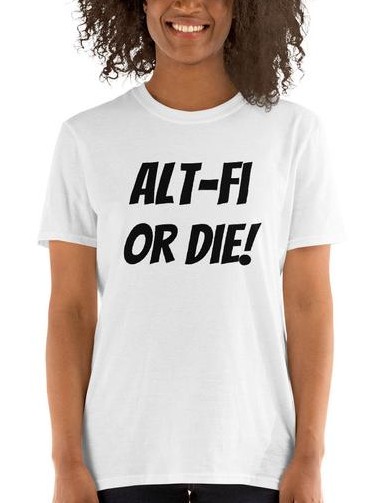
Hey, does anyone from the SJW wing of mainstream FI want to adorn this t-shirt at this year’s FinCon? Heck, if you’re game, I’ll even gift you the t-shirt.

And don’t forget my MAGA t-shirt. Haha! I bet you thought MAGA stood for something else.

Sorry. I just had to throw this t-shirt into the mix. Those who have read my post about what’s in store for Freedom Is Groovy in 2019 will understand it.

And don’t forget to check out my book!


Leave a Reply to B. Weil Cancel reply