
This post may contain affiliate links. Please read our disclosure for more information.

In the early 80s, two social scientists, James Q. Wilson and George Kelling, came up with a crime-abatement theory called broken windows.
In a nutshell, the broken windows theory goes like this:
- Broken windows on a building or a home that aren’t fixed send the message that the owners of the structure don’t care.
- Since the owners don’t care, the penalty or stigma associated with destructive behavior (breaking windows) is removed, and more people engage in the destructive behavior (they break more windows). The act of not caring thus creates a twisted subsidy, if you will. And people respond accordingly. Whatever you subsidize, you get more of.
- Petty crimes in a neighborhood act as a sort of broken window. If they aren’t addressed, they send the message that the authorities don’t care, and more people than otherwise are emboldened to commit crimes. Hey, everyone’s doing it, right? A twisted subsidy in action again.
I came across the broken windows theory in graduate school and found it very intriguing. In fact, I found it so intriguing, I decided to test it at work.
Broken Windows at Work
In the early 2000s, I was made foreman of a highway crew at my lovely government job, and one of my responsibilities was to maintain a mile-long stretch of grass that ran along Radcliffe Road in a town called Plainview. My municipality’s definition of “maintain,” however, wasn’t very comprehensive. The only thing my crew and I were required to do was cut the grass once a month during the growing season (roughly April through October). That was it. We weren’t required to edge the grass or prune the flora along the fence line. Nor were we required to rid the commons of litter. If we did anything that resembled honest maintenance, it was only because homeowner complaints about the lack of tidiness in the commons were too numerous to ignore.
My municipality’s definition of maintenance was the essence of a broken window. Take a look at the Google Maps street view of Radcliffe Road below. This is from September 2012. And its condition isn’t too bad. There’s some litter and the fence line looks like it could use a little weed-whacking. But it’s nothing compared to the Radcliffe Road I inherited in the early 2000s. The fence line back then looked like a jungle, the grass was overgrown and encroaching upon the roadway, and litter was everywhere. We in effect told the community that we didn’t care. And the more wayward members of the community behaved accordingly. They were emboldened to use the Radcliffe Road commons as an undocumented garbage dump.
Since I thought my municipality’s definition of maintenance was bullsh*t, and since I had developed a keen interest in the broken windows theory, I enacted the following maintenance schedule for the Radcliffe Road commons.
- Cut grass once a week.
- Edge and weed whack every two weeks.
- Trim the flora along the fence line once a month.
- Pick up litter every day.
Needless to say, my crew thought I was a douche for enacting the above maintenance schedule (hell hath no fury like bureaucrats suddenly told to exceed long-established norms). But that’s okay. They thought I was a douche before I decided to test the broken windows theory. What really concerns us here is the results. Did the community respond positively to my rigorous maintenance schedule? Yes—resoundingly so. I made Wilson and Kelling proud. As soon as we started caring about the Radcliffe Road commons, the community started caring about it too. In fact, acts of littering dropped so precipitously, I freed my crew from litter duty and began policing the Radcliffe Road commons all by myself. And I would go days without seeing so much as a candy wrapper.
It’s amazing what happens when you fix a broken window.
The Broken Windows of Personal Finance
Don’t ask me why, but I’ve been thinking about the broken windows theory again—especially as it relates to personal finance. When I was growing up, there were a lot of broken financial windows in my family and community; that is, there were a lot of destructive financial behaviors that were socially acceptable because most adults either engaged in them or considered them relatively benign or unimportant. Here are some examples of what I mean.
Smoking. Cigarettes had warning labels when I was growing up, but smoking still had a lot of cachet and was an integral part of American life. Everywhere you went, people smoked. They smoked in cars, homes, restaurants, supermarkets, office buildings, airplanes, elevators, movie theaters, and stadiums. Hardly any place populated by humans was off limits. Heck, Mrs. Groovy even remembers her childhood physician smoking while he was examining her—and she was allergic to tobacco! Yes, it was that bad. And while a few adults in my life warned me about the negative long-term health consequences of smoking, not a single adult ever warned me about the negative long-term financial consequences of spending a crapload of money on cigarettes rather than investing that money in mutual funds.
Fortunately for me, I had a natural revulsion to this foul habit. So I never smoked a cigarette in my life. But a lot of my peers weren’t so lucky, and they got sucked into the tobacco vortex by the twisted subsidy of social acceptance.
Watching television. I shudder to think how much television I watched in my youth. Save for meals, homework, and chores, being in the house meant being in front of the television. My guess is that I easily watched 5-7 hours of television a day. What a colossal waste. Imagine if I would have used just a quarter of that time to read a book instead. Maybe I wouldn’t have gotten a verbal score on my SAT that placed me in the vicinity of functional illiteracy.
Buying cars on credit. No one I knew growing up ever considered the financial damage caused by using debt to buy rapidly depreciating hunks of shiny metal from Detroit. Having a car payment was as customary and natural as the sun rising in the east. In 1986, less than two years removed from college, I bought my first car on credit. And I had a car payment practically every month since then until May of 2006. That equates to several cars and nearly 252 consecutive months of car payments. Ouch!
Taking education only semi-seriously. My parents knew the importance of education. And so did most of the parents in my corner of suburbia. But their commitment to it wasn’t fierce. There were no tiger moms in my neighborhood growing up. Come home with mostly Bs and you were good to go. There would be no recriminations for plopping down in front of the television. No recriminations for failing to open a book. And no recriminations for obsessing over sports and dating.
Thinking that investing in the stock market was only for rich people. No adult in my youth ever expressed an interest in the stock market. Adults in my youth were decidedly middle class—people who drove trucks, delivered mail, put out fires, worked in factories, and waited on tables. And they didn’t buy stocks. They knew their place—they relied on homeownership and pensions to build wealth. Stocks were for the Thurston Howells of the world.
Embracing the siren call of materialism. More is better. Bigger is better. Newer is better. The adults in my youth had no idea how damaging this mindset was to their financial well-being. So they gladly jumped onto the hamster wheel and so did most of their children. This is a big reason why I basically lived paycheck to paycheck until I was in my early 40s. Before I finally discovered the emptiness of materialism—that is, before I discovered that more stuff wasn’t going to bring me lasting happiness or fulfillment—I found it far easier to bear the burden of debt and financial brinkmanship than bear the burden of not having the “right” clothes, the “right” cable package, the “right” car, and the “right” mailing address.
Now, before I go any further, I need to defend the adults in my youth.
First, the broken financial windows that they failed to fix were bad, not disastrous. There’s a huge difference between buying a car on credit and, say, procreating while still in high school. The former may set you back a few years. The latter may set you back a few decades. In other words, the adults in my youth avoided the really big financial mistakes. They didn’t drop out of high school, they didn’t procreate out of wedlock, they didn’t engage in violent crime, and they didn’t shy away from gainful employment (they worked their asses off, actually). And these financial-friendly virtues were passed on to me and all the other kids in the neighborhood.
Second, the adults in my youth allowed broken financial windows to fester, not because they didn’t care, but because they didn’t know any better. Back in the 60s and 70s, for instance, a high school degree was still a worthwhile credential. Anyone armed with a high school diploma and a penchant for hard work and competency could move up the job ladder in most fields and at most companies. America’s labor market back then was far less infected by credentialism than it is today. You didn’t need a BA to reach middle management, much less get a job interview. Also, back in the 60s and 70s, factory jobs and pensions were much more prevalent. Personal finance for my parents’ generation was thus far less complicated. You got a job, worked forty years, and then retired comfortably with a pension check and a Social Security check. Easy peasy. My parents’ generation had no idea that private pensions would be replaced with 401(k)s and that most factory jobs would fall victim to automation and globalization. The bottom line is this: you can’t blame people for not fixing broken financial windows—such as being lackadaisical toward higher education and being ignorant of stock investing—when those broken financial windows weren’t a serious problem for them.
Okay, having just made a rousing defense of my parents’ generation, it’s now time to explore how one fixes the broken financial windows in one’s life.
How to Fix the Broken Windows of Personal Finance
This is a tough one. Unlike crime and maintenance of the commons, there’s no external authority that can come into a community and force the adults living there to be good role models and fix their broken financial windows. When it comes to the broken windows of personal finance, you’re the only one who can care. It’s all on you. You’re going to have to turn inward and become super disciplined and super demanding. You’re going to have to place your right hand on the financial bible (Dave Ramsey’s Total Money Makeover) and swear that you will no longer engage in financial behaviors that are moronic but socially acceptable.
The good news is that you can fix your broken financial windows all by your lonesome. Here’s how.
Step One: Determine If There’s a Problem
The first thing you have to do to fix the broken financial windows in your life is make an honest assessment of your financial well-being. Are you financially fit? Or are you a financial train wreck? To help you in this regard, I’ve devised several questions you need to ask yourself. If you answer “yes” to any one of them, the odds are high that you’re a financial train wreck and there are several broken financial windows in your life. If you answer “yes” to two or more of them, you assuredly are a financial train wreck and have several broken financial windows in your life.
- Do you work less than 40 hours a week?
- Are you living paycheck to paycheck?
- Would a $400 car repair bill be a crisis—that is, would a $400 car repair bill mean going hungry, missing a rent payment, or delaying a needed trip to the doctor?
- Do you need to own the latest iPhone, wear designer clothes, drive a late-model car, or frequent the hottest nightclubs in order to feel good about yourself?
- Have you invested more in tattoos and body piercings than stocks?
- Do you spend more hours playing video games than reading books?
- Have you produced any children out of wedlock?
- Do your friends have more felonies than bachelor degrees?
- Do you party hard—that is, do you drink a lot of alcohol and do a lot of drugs?
- Do you live in a trailer park or a neighborhood that has its first-story windows decorated with security bars?
Step Two: Identify the Broken Financial Windows in Your Life
Assuming for the moment that your answers to the above questions prove you’re a financial train wreck, the second thing you have to do to fix the broken financial windows in your life is to identify those broken financial windows. This can be done quite easily if you have an internet connection. Just go to YouTube, do a search on “poor habits rich habits,” and then start binge-watching the videos that come up. Here are ten videos from that search that I highly recommend.
- 15 Things Poor People Do That The Rich Don’t (Alux)
- 15 Sacrifices You Need To Make If You Want To Be Rich (Alux)
- The Habits Of The Rich Vs. The Habits Of The Poor (His and Her Money)
- Why You Are Still Broke (Practical Wisdom)
- Rich Spending Vs. Poor Spending (Ryan Scribner)
- Five Expensive Money Habits That Are Killing Your Wallet (Minority Mindset)
- 12 Things Rich People Do That The Poor Don’t (The Better Men Project)
- 8 Things That Wealthy People Do Differently (The Financial Diet)
- These 6 Rich People Habits Changed My Life (Jeff Rose)
- Jim Rohn: The Philosophy Of The Rich And The Poor (Habits of the Wealthy)
After watching a bunch of these videos, you’ll be able to identify at least ten financially stupid things that you and most adults in your community do. These are your broken financial windows. These are the wretched money habits you need to fix.
Step Three: Fix the Broken Financial Windows in Your Life
After you have identified the broken financial windows in your life, the final thing you have to do is fix them. In one respect, this is the easy part. All you do is stop doing the socially acceptable but financially stupid things you’ve been doing and do the opposite. For instance, let’s look at my broken financial windows and see what I did to fix them.
Smoking. This was super easy. Just because the adults in my life found smoking acceptable didn’t mean that I had to. The stench of cigarettes always made me wretch and I have always avoided them like the plague.
Watching television. I stopped watching sports and got rid of cable. This reduced my television watching to maybe an hour a day (I curse you YouTube and Netflix).
Buying cars on credit. In 2006, I made the last car payment of my life. Mrs. Groovy and I purchased our current car in 2008. It was a 2004 Camry and we paid for it with cash. We’ll probably buy a new-to-us car in a year or so and we already have the money set aside for it.
Taking education only semi-seriously. In my late 20s, I developed a love for books and reading. In my late 30s, I taught myself databases and programming. I also went back to college at this time and got a master’s degree. I wouldn’t describe myself as a renaissance man, but I would describe myself as a life-long learner (i.e., a recovering dullard).
Thinking that investing in the stock market was only for rich people. As soon as Mrs. Groovy and I moved down to Charlotte from Long Island in 2006, we each opened a Roth IRA. We’ve been students of investing and Bogleheads ever since. VTSAX all the way, baby!
Embracing the siren call of materialism. Remember my 2004 Camry I mentioned a few paragraphs above? Well, I’m still driving that old-man car. It has 180,000 miles on it and it is easily the worst car on the block. And I love it.
Fixing broken financial windows isn’t hard once you decide to fix them. What is hard is overcoming the inertia of habits and culture. Here are four things to help you in your quest to overcome that inertia.
Drop your ego. You’re not awesome. You’re not the “next big thing.” You’re a broke schmuck. So get over yourself and admit that you don’t know what the hell you’re doing when it comes to personal finance. There’s no shame in admitting this. Nor is there any shame in asking for help.
Don’t blame the system. Blaming the system is a dodge. Fix your broken financial windows first and then get back to me about the system. If you’re still struggling financially then, I’ll not only concede that the system is to blame, I’ll be the first one to join in the revival of Occupy Wall Street. “Hey-hey, ho-ho. Goldman Sachs has got to go.”
Don’t get hamstrung by guilt. You’re not disrespecting your parents if you decide to fix the broken financial windows that they passed on to you. Nor are you a traitor to your community or tribe if you decide to fix the broken financial habits that they passed on to you as well. Remember: in Groovyland, we don’t engage in ex post facto finger-pointing. There’s a good chance that the bad money habits so prevalent in your world today were once good or benign money habits. In other words, the adults in your life are neither stupid nor lazy. Their money habits just may not work for someone wanting to get ahead today. Different circumstances call for different strategies. And you’re not an ingrate or a sell-out for recognizing this.
Find a new tribe if your current tribe fights you. I’ll never forget the answer a co-worker gave me when I asked her why she moved from Buffalo to Charlotte. She told me she would have never gotten out of poverty if she remained in Buffalo. Her family was that toxic. Sometimes finding a tribe that will support your financial rebirth means moving to another state. Sometimes it means joining the military. And sometimes it means befriending a virtual community made up of nut-job bloggers who go by such colorful names as Mr. Money Mustache, J Money, Crispy Doc, and Miss Mazuma.
Okay, groovy freedomist, that ends my rumination on broken windows and personal finance. I don’t know if this attempt at behavioral economics makes any sense, but it sure gave me plenty of fodder for a blog post. Let’s now turn our attention to Groovy Ranch.
Groovy Ranch Is Nearing the Finish Line
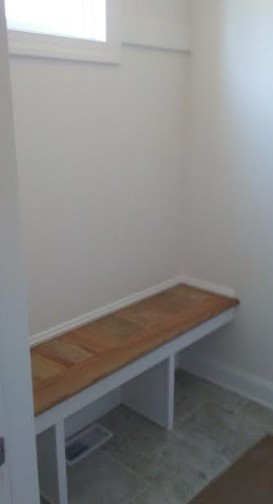
A lot of sh*t is happening at Groovy Ranch. The bench in the utility room has been stained and finished.
The appliances have been delivered and they all should be installed by the end of today.

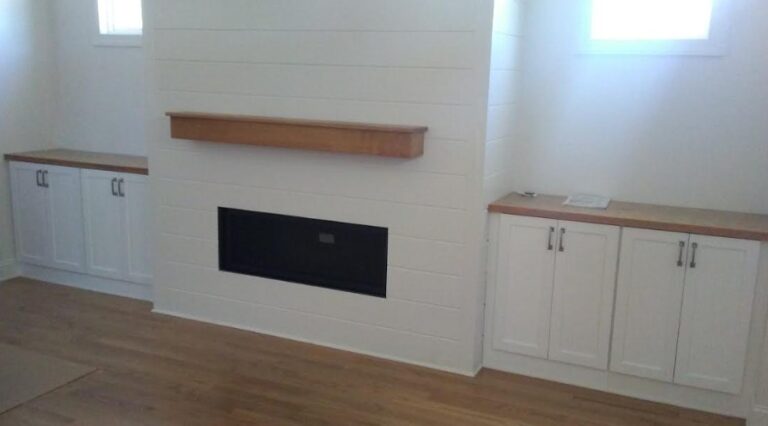
And the built-ins and the fireplace mantel are complete.
Final Thoughts
Okay, groovy freedomist, that’s all I got. What say you? Did your parents and community burden you with any broken financial windows? And if they did, how did you go about fixing them? Let me know when you get a chance. Peace.


Leave a Reply to David @iretiredyoung Cancel reply