This post may contain affiliate links. Please read our disclosure for more information.

Mrs. Groovy and I are big fans of Peyton Place, which we watch on YouTube. For those of you who aren’t familiar with Peyton Place, it was the first nighttime soap opera in television history. It ran from 1964 to 1969.
Anyway, it was based on a book of the same name. Peyton Place was written in 1956 by Grace Metalious. It was on the New York Times bestseller list for 59 weeks and sold over 8 million copies.
Needless to say, the book is quite different from the television series. The television series takes place in the 60s. The book, however, takes place in the late 1930s. And what makes this pertinent to this post is the housing occupied by the poor people in the Peyton Place book. Metalious describes the housing as “tar paper shacks,” and one of the book’s villains, Lucas Cross, lives in one. Here’s how Metalious describes Lucas’s tribe and the quality of their housing.
Lucas was referred to as a woodsman, but had he lived in another section of America, he might have been called an Okie, or a hillbilly, or poor white trash….What the woodsman knew, he knew by instinct, from listening to conversation, or, rarely, from observation….He lived in rickety wooden buildings which were covered on the outside with tar paper instead of clapboards, and his house was without water or swerage.
Later in the book, we get a view of Lucas’s one-room tar-paper shack via the book’s protagonist, Allison—who was friends with Lucas’s stepdaughter Selena.
So this is what the inside of a shack looks like, thought Allison, fascinated. Her eyes took in the unmade cots and the sagging double bed and the dirty dishes which seemed to be strewn from one end of the room to the other. She saw a garbage can in one corner which had not been emptied in a long time, and on the floor next to it was an empty can that had once held tomatoes and one that had contained beans. Lucas was sitting at a table that was covered with a streaked oil cloth so old and filthy that the pattern in it was no longer discernible, and Selena was filling a coffeepot from a pail of water, with a long-handled dipper.
A tar-paper shack doesn’t strike me as very appealing housing. And the scary part is that we’re not too far removed from the era in which this kind of housing was quite common. My father was born in 1940. So we’re not talking ancient history here. Consider the following, courtesy of James D. Lutz, a scientist at the Lawrence Berkeley National Laboratory:
- In 1920, only one percent of American homes had electricity and indoor plumbing.
- In 1940, nearly half of American homes lacked either hot water, a bathtub or shower, or a toilet. Over a third didn’t have a flush toilet.
- In 1940, half of all American homes were heated with coal. Another 25 percent were heated with wood.
The Miracle of the Modern Home
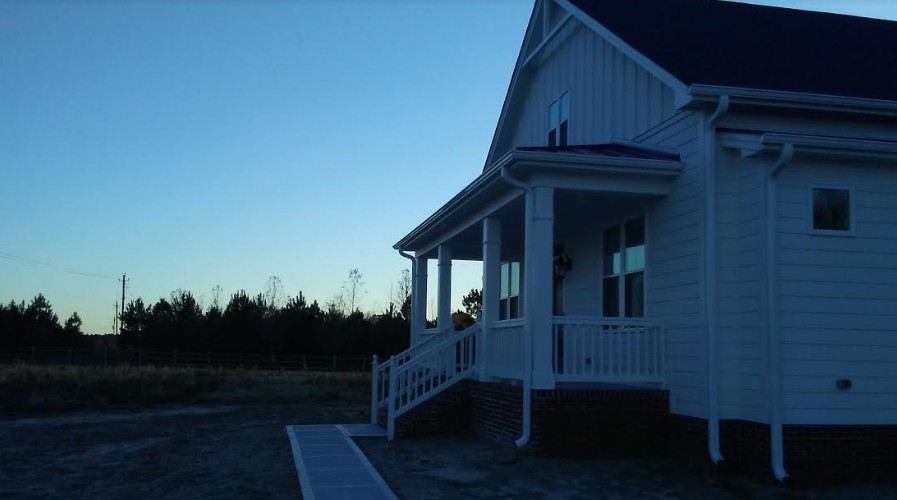
Yes, American housing has come a long way since the first half of the 20th century. What is considered standard housing today is actually quite opulent by historical standards. Consider Groovy Ranch which was completed this past December. Here are just some of its mundane features:
Water: Three faucets and two shower heads. There’s also water connections for the refrigerator, the dishwasher, and the washing machine and two water spigots on the outside of the house.
Hot water: By merely turning a lever, I get 120-degree water in the kitchen and two showers whenever I want. No need to heat water on a stove top.
Ice: Without me doing anything, my refrigerator provides me with all the ice cubes I could possibly need.
Heat: We have a heat pump. And apparently, it acts as a reverse air conditioner during the cold months. It takes heat from the ambient air and pumps that warm air into the house. I’m not a fan. When the temperature gets below 40 degrees, there’s not enough heat in the ambient air to pump into the house. An auxiliary heat strip kicks in to produce heat and that auxiliary heat is expensive. Thankfully, the number of days below 40 degrees here in North Carolina are mercifully few. Also, we have a kick-ass gas fireplace to augment our heat pump and heat strip.
Gas fireplace: By simply pushing a button on a remote, I get a beautiful fire in my family room in seconds. Here’s a picture. And, man, does it throw off heat. After about a half hour or so, Mrs. Groovy informs me that her legs “are melting,” and that’s my cue to turn the beast off.

Air conditioning: Haven’t used it yet. But we’re rapidly approaching the spring and summer, and I’ll know soon enough if our system is adequate. I don’t have any worries, though. We have a 16 SEER Trane and Trane is a respected brand. We also have screened windows that are easily opened and ceiling fans to fall back on if more primitive ways of cooling a house are required.
Electricity: My grandmother on my father’s side came from a coal mining town in Pennsylvania. Her father worked in a coal mine and they lived in a classic company owned town. The company owned the house my grandmother lived in and operated the store my great grandmother shopped at. Anyway, I’m telling you this because my grandmother loved telling the story of when she was a little girl and the company decided to supply her home with electricity. It was one light bulb hanging from the ceiling in the kitchen. Now let’s contrast the electrical footprint of my grandmother’s childhood home with Groovy Ranch’s electrical footprint.
- The number of recessed lights: 29 (28 interior, 1 exterior)
- Ceiling lights: 5 (1 in each hallway, 1 in the foyer, and two in the master closet)
- Exterior lights: 6 (four on the house and two on the garage)
- Kitchen pendants: 2
- Electrical outlets: 52 (45 in the house, 4 in the garage, 1 outside the garage, 1 in the screened-in porch, and 1 on the front porch)
- The house has 200 amp service and the garage has 100 amp service. I don’t know exactly what that means, but our builder says that’s more than enough capacity to handle any additions we might want to our electrical footprint and to run power tools in the garage.
Televisions: We have three smart televisions that are all connected to our internet service wirelessly. Two forty-inch flatscreens and one fifty-inch flatscreen. We watch regular television with a DirectTV Now subscription ($40 per month) and each television has a built-in streaming capability for all the major players in the streaming game (e.g., Netflix, Hulu, YouTube, etc.).
Internet: We were a little nervous about living in the country. We have far more four-legged neighbors than two-legged neighbors, and we didn’t know if we’d even get internet service. Thankfully, CenturyLink is in the area and its internet service has been a pleasant surprise. I just ran a speed test on our service and it registered a speed of 15.9 Mbps. Not lightning fast, but more than adequate for our needs.
I could go on, of course, but you get the picture. Groovy Ranch is a staggering testament to mankind’s ingenuity and organizational prowess. And when I contemplate Groovy Ranch, I can’t help but think of “I, Pencil,” a classic in economic literature. If you haven’t read it, please do. The author, Leonard Read, tells us in marvelous fashion all that went into making a number two pencil back in the day. Here’s a glimpse:
- Trees are harvested in Northern California and Oregon.
- Logs are then shipped via rail to a mill in San Leandro, California.
- The logs are then cut into pencil-length slats less than a quarter of an inch in thickness and kiln dried. The mill’s power comes from a concrete dam operated by Pacific Gas & Electric.
- The kiln-dried, pencil-length slats are then sent to the pencil factory. There, a machine gives each slat eight grooves. Then another machine lays “lead” in every other slat, applies glue, and places one slat on top of another. The resulting “lead sandwich” forms the basis of a pencil.
- The “lead,” in turn, isn’t lead at all. It’s graphite mixed with clay. The graphite comes from Sri Lanka, and the clay comes from Mississippi.
- The outside of the pencil then gets six coats of lacquer. One of the ingredients of lacquer is castor oil. Who knew that farmers of castor beans were integral to the creation of a pencil.
- The pencil’s ferrule is made of brass. In order to make brass, you need to mine zinc and copper.
- And, finally, the eraser is made from combining sulfur chloride with rapeseed oil and pumice. The rapeseed oil comes from Indonesia. The pumice comes from Italy.
And this is what it took to make a simple pencil. How many people, in how many far-off lands, did it take to bring Groovy Ranch to life? The mind boggles.
I’m a One Percenter
In one sense, Groovy Ranch is hardly remarkable. No one reading this post would fall down in disbelief if he or she ever visited Groovy Ranch. By today’s standards, it’s far from opulent. It’s just standard middle-class housing in America.
But in another sense, Groovy Ranch is indeed remarkable. Compare Groovy Ranch to a standard 1,500 square foot home in the year 2000. Aside from the flatscreen televisions, it wouldn’t be much more opulent. But how about compared to the typical 1980 home? And what about the typical 1960, 1940, and 1920 homes? And what about any home on the planet prior to 1900?
Now, to really put the opulence of Groovy Ranch into perspective, consider this. Julius Caesar is one of the most famous human beings to ever walk the earth. To get the state-of-the-art housing that he enjoyed, he had to conquer most of Europe and large swathes of the Middle East and Africa. My housing on the other hand—the fabulous Groovy Ranch—blows his housing away. And the only thing I had to conquer in order to secure it was my penchant for wasting a ridiculous amount of money on booze, burritos, and shiny baubles.
I’m not a one percenter today. But I’m a one percenter compared to anyone living in any era prior to 2000.
Final Thoughts
Okay, groovy freedomist, that’s all I got. What say you? I think the typical American, assuming he lives in the typical American home, is living like a king. Is this crazy talk? Or have I accurately described typical American housing in the early part of the 21st century? Let me know what you think when you get a chance. Peace.


Leave a Reply to freddy smidlap Cancel reply